Independent study by Anchit Tandon, who worked on Times Health+ at Times Internet until April 2026. Uses public information only. Not affiliated with Times Internet or The Times of India.
Times Health StudyIdeas
Ideation

From fixes to bets: seventeen ideas, three worth building

Lens 1

From a root cause

Each problem and gap became a question starting "How might we".

Lens 2

Borrowed from another industry

Who has already solved this shape of problem, in music, fitness, insurance or news abroad?

Lens 3

From an asset only it owns

What does Times Health own that a rival would have to build or buy?

How might we...

  • How might we let someone decide in ten seconds, without giving a phone number?From the price shown only after a one-time code.
  • How might we make a missed class the start of a comeback, not the end of the week?From fixed slots, and day-30 retention of 3 to 8%.
  • How might we sell a result, not a class?From 23.7 crore Indians with diabetes or prediabetes, and a diet team already in place.
  • How might we turn a race bib into a year of practice?From a race audience that leaves on race day.
  • How might we make paying reward practising?From research showing users pay for gym memberships they barely use.
  • How might we turn TOI's reach into the right first class for each reader?From reach that lands on one generic page.
The idea wall

17 ideas, scored

Each idea gets three ratings from 1 to 5: how much it helps, how sure I am it works, and how easy it is to build. Multiplied together, they give a score out of 125. Ideas that feed a big bet are marked; those help most but take longer to build.

Do first

High value, easy to build

Worth the effort

High value, harder to build

Easy extras

Some value, easy to build

Later

Some value, harder to build

#IdeaImpactConfidenceEaseScoreHelps at step
T1Price-first page: plans, the trial and the next eight class times, before any sign-upFrom a root cause: the price is hidden behind an OTP455100Decide (choosing to try)
T2Catch-up for every class, plus a 20-minute short versionFrom a root cause: miss the slot and the habit breaks54480Start (first classes), Stick (keeping the habit)
T6Series passport: a stamp for each city, a returning-runner price, a medal for all fourBorrowed from another industry: marathon series that reward finishing several races44464Grow (more programmes, races)
T13Bundle onboarding: a guided first week for ET Prime's three free monthsFrom an asset only it owns: the ET Prime bundle34560Discover (finding it), Start (first classes)
T10Story to programme: a 30-second quiz on TOI health stories that routes to the right programmeFrom an asset only it owns: TOI's health coverage43448Discover (finding it)
T15Recovery after the race: a 30-day mobility programme, then the next cityFrom an asset only it owns: its own race series34448Grow (more programmes, races)
T17Smog-day plan: when Delhi's air is poor, race training switches to indoor yoga and strengthFrom an asset only it owns: its race series and TOI's air-quality coverage34448Stick (keeping the habit)
T7Bib to habit: registering starts a training plan with yoga for runnersFrom an asset only it owns: its own race series44348Discover (finding it), Stick (keeping the habit)
T4Practise to pay less: practise 12 times in the first month and part of the fee comes back as creditBorrowed from another industry: commitment research in behavioural economics43336Stick (keeping the habit)
T8Corporate league: company teams across the four cities, with yoga seats for trainingFrom an asset only it owns: the race category for senior executives and the corporate page43336Grow (more programmes, races)
T9Live shout-outs in class, and a weekly streak card on WhatsAppBorrowed from another industry: shout-outs in live fitness classes33436Stick (keeping the habit)
T3Outcome programmes: 12 weeks of yoga and food for one condition, one number tracked, a report to share with your doctorFrom an asset only it owns: the diet team and The Yoga Institute53230Grow (more programmes, races)
T11Big-screen mode: cast classes to the TVBorrowed from another industry: video apps on the living-room TV33327Stick (keeping the habit)
T12Parents' plan: gentle chair yoga for users over 60, paid by a child who gets a weekly noteBorrowed from another industry: family plans33327Grow (more programmes, races)
T16Doctor referral: diabetologists give patients a code for the 12-week programmeBorrowed from another industry: doctors prescribing activity, not only medicine42324Discover (finding it), Grow (more programmes, races)
T14Wearable sync: steps and sleep fill in the weekly check-inBorrowed from another industry: phone health apps33218Stick (keeping the habit)
T5Insurer-funded programmes: classes that count as active days for insurers that reward activityBorrowed from another industry: health insurance that refunds premium for active days42216Grow (more programmes, races)
The big bets

Three bets worth building, in depth

Big bet 1 · combines T3, T5, T10

Outcome programmes: pay for a result, not a class

23.7 crore Indians have diabetes or prediabetes. Diabetes coaching apps already track numbers, but none is built around yoga. Times Health has a diet team for 16+ conditions and The Yoga Institute's teachers, and sells them apart.

  1. A reader of a TOI story on blood sugar takes a 30-second quiz and is shown the prediabetes programme, with its price.
  2. After a safety screen, they get the right classes, a weekly diet consult and one number to track: a lab HbA1c test (average blood sugar over about three months) at the start and at week 12.
  3. Each week they log practice and food; at week 12, a one-page report to share with their doctor.
  4. The programme can be paid by the person, an employer, or an insurer that rewards active days.

Why Times Health can win this

Credibility from The Yoga Institute, a diet team already serving these conditions, and TOI's health readers as the front door. Diabetes apps have the tracking but not the yoga or the reach.

How it makes money

A programme price for 12 weeks, above general yoga because it sells a result. Partners can pay too: Aditya Birla Health Insurance already refunds part of the premium for days a customer is active, up to 100% on one plan; an insurer would need to accept these classes as active days.

Cheapest first test

One programme (prediabetes), 200 users, 12 weeks, with a medical reviewer and a waitlist group (users who start later) for comparison. Measure completion and the change in HbA1c, and report it honestly whatever it shows.

What could go wrong

Health claims: ethics review before publishing outcomes, legal review of every claim against India's advertising rules, never promise results, and send users who need a doctor to one first. Health data shared with an insurer needs its own consent. Insurer deals are slow, so the programme must stand on paying users alone.

Stop if: fewer than 40% of the pilot complete the 12 weeks, or the typical HbA1c change is no better than the waitlist group's.

Sources: ICMR-INDIAB 2023 (report) · Aditya Birla Health premium-back plan (Outlook Money) · Sugar.fit · Fitterfly
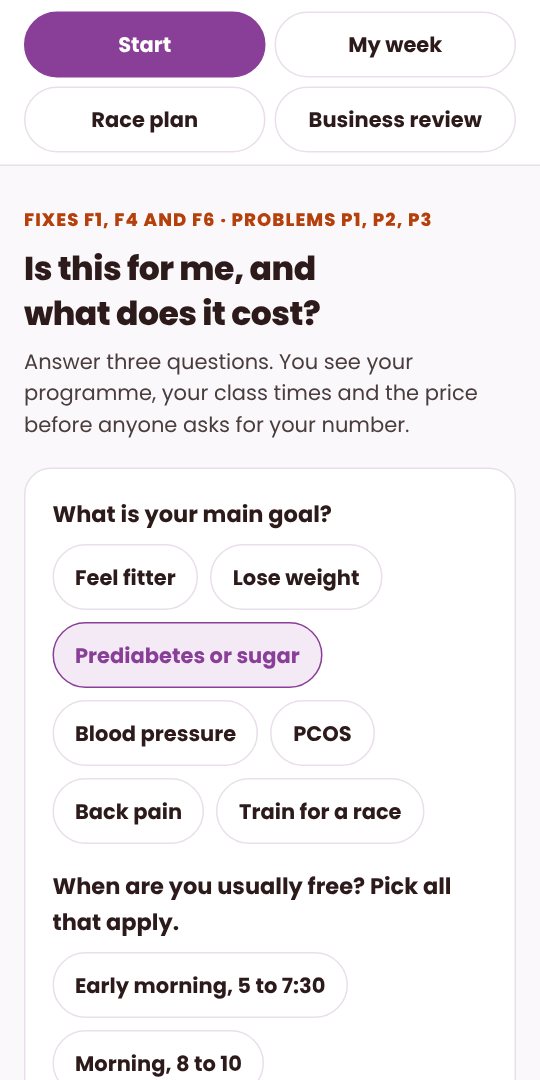
The Start screen in the working model: the 12-week blood sugar programme with class times and its price
From the working model: a condition programme with its price and class times, before any sign-up. Try it in the working model →
Big bet 2 · combines T6, T7, T8, T15

Race to habit: the series passport

The Delhi race had 18K+ runners, by my launch figure, against 40,000+ at the long-established Delhi Half Marathon. A new series will not win on size. It can win on the weeks before and after race day, where today it offers articles, not a plan, and nothing after the finish.

  1. At registration, runners can opt in to a free training plan with yoga for runners; first-timers get the gentler plan.
  2. Race week brings the heat and air-quality plan; the finish brings results, photos and the certificate the same day.
  3. A 30-day recovery programme, then a stamp in the series passport and a returning-runner price for the next city.
  4. Companies enter teams across all four cities, with yoga seats for training.

Why Times Health can win this

It is the only series in the calendar owned by a company that also runs a daily yoga product and The Times of India. The pieces exist; they are not connected.

How it makes money

New members from runners: 150 to 1,200 a year on the working model: 150 if results only just pass the stop lines, 1,200 at its default rates. Plus repeat registrations across cities, and corporate team fees.

Cheapest first test

Run it for the Mumbai race on 14 Feb 2027, 15 weeks out, offering the plan to half of registrants. Measure plan starts, trial starts and repeat registrations against the other half.

What could go wrong

Injury from a rushed plan: build gradually, and hold the plan back when there are too few weeks before the race, as the working model does. Registration data is collected for the race, so the training offer needs its own opt-in. Race dates can move, so the passport must survive a rescheduled race.

Stop if: fewer than 20% of registrants start the plan, or fewer than 5% of plan users start a yoga trial.

Sources: Delhi Half Marathon, 40,000+ (News On Air) · Race tickets and FAQ (District)

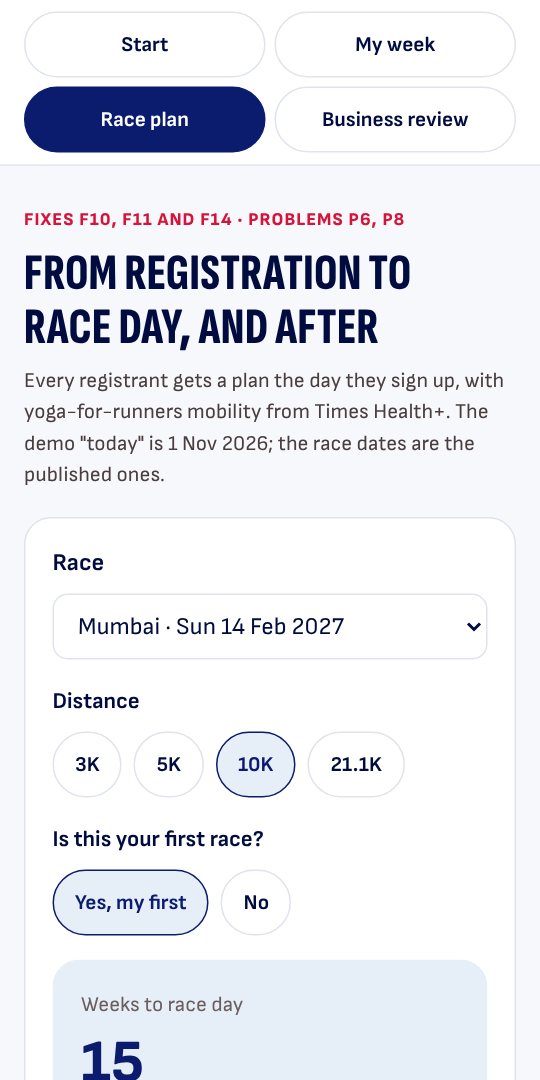
The race plan in the working model: a week-by-week plan to the Mumbai race
From the working model: a week-by-week plan from registration to race day. Try it in the working model →
Big bet 3 · combines T4, T2, T9

Practise to pay less

Users pay for exercise they do not do. In one study, gym members on flat fees of over $70 a month went 4.3 times a month, paying over $17 a visit when a $10 per-visit pass was available. Linking money to the behaviour helps: smokers offered a deposit they got back only if they quit were 3 points more likely to quit, and it lasted. This idea uses a gentler version, a reward rather than a deposit.

  1. At sign-up, the price comes with one line: practise 12 times this month and get part of it back as credit.
  2. Every live or catch-up class counts; a tracker shows "7 of 12".
  3. Miss two days and a 20-minute catch-up appears, with a shout-out when it is done.
  4. Reach 12 and the credit is applied to the next renewal; by then, the habit is formed.

Why Times Health can win this

Live classes plus catch-ups make the target reachable for busy users. A rival could copy the credit, so the edge is speed: it is cheap to test now. The credit is paid only when earned, by the members most likely to renew.

How it makes money

The credit is funded by higher renewal among the members who earn it, and set below the value of the renewals it adds.

Cheapest first test

A randomised test on new trials: half get the offer, half do not. Measure practice days in week four, renewal in month two, and the cost of credits.

What could go wrong

It can feel like a gimmick or hidden fine print: say it in one plain sentence. Users who already practise get credit they did not need, so cap it and measure the net effect.

Stop if: the extra renewal money is less than the credits cost, over two months of new members.

Sources: "Paying Not to Go to the Gym", AER 2006 · Commitment contract study, AEJ 2010

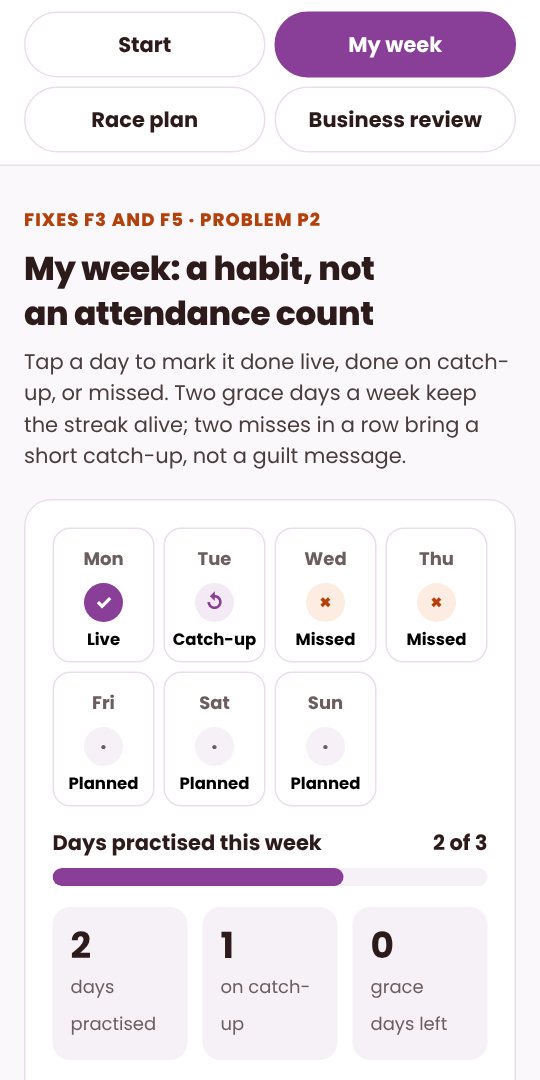
The My week screen in the working model: days marked live, catch-up or missed, with a catch-up nudge
From the working model: the week view, where two missed days bring a 20-minute catch-up. Try it in the working model →
Judgement

Tempting ideas I would not do, and why

  • Match cult.fit at ₹1,859 a year. It makes Times Health the cheaper, smaller library. Price is not why users stop in week three.
  • Build a 1,000-class library before anything else. Recording the classes it already teaches, plus the 687 videos already published, gives the same flexibility at a fraction of the cost.
  • Sign a celebrity for monthly masterclasses. It brings reach for a day and does nothing for week three.
  • Launch a separate app for each product. It splits yoga, diet and races further. One account across all three comes first.
  • Spend on marketing to make the race bigger. It would still be smaller than the Delhi Half Marathon. The edge is before and after race day, not the size of the start line.

The near-term work is on the fixes page; how I would sequence it and measure it is on the plan page.