Independent study by Anchit Tandon, who worked on ET Prime and ET Markets at Times Internet until April 2026. Uses public information only; career figures are as published on my portfolio. Not affiliated with The Economic Times or Times Internet.
ET StudyIdeas
Ideation

From fixes to bets: seventeen ideas, three worth building

Lens 1

From a root cause

Each problem and gap became a question starting "How might we".

Lens 2

Borrowed from another industry

Who has already solved this shape of problem, in music, fitness, insurance or news abroad?

Lens 3

From an asset only it owns

What does ET own that a rival would have to build or buy?

How might we...

  • How might we make paying feel better than not paying, from the first day?From P1 and P2: members get ads, pop-ups, calls and lock-outs.
  • How might we give readers a reason to open ET every day that Google cannot take away?From P6, and 4.1 minutes a month per visitor.
  • How might we make ₹2,399 feel obviously worth more than ₹499?From the in-app price gap with Moneycontrol Pro.
  • How might we turn every investor's holdings into ET's front page?From the gap analysis: no one explains the news against a reader's portfolio.
  • How might we be the answer when readers ask an AI instead of searching?From weekly AI chatbot use for news rising to 10%.
  • How might we sell to companies, not only to individual readers?From corporate plans that exist but are not a product.
The idea wall

17 ideas, scored

Each idea gets three ratings from 1 to 5: how much it helps, how sure I am it works, and how easy it is to build. Multiplied together, they give a score out of 125. Ideas that feed a big bet are marked; those help most but take longer to build.

Do first

High value, easy to build

Worth the effort

High value, harder to build

Easy extras

Some value, easy to build

#IdeaImpactConfidenceEaseScoreHelps at step
I1Member mode: at most one ad per story and no pop-ups or offers for anyone who has paidFrom a root cause: paying members are still sold to like new visitors54480Keep (renewing)
I12Pause, not cancel: a one-tap pause and a value receipt before every renewalBorrowed from another industry: pause in streaming and fitness memberships44464Keep (renewing)
I10Gift a month: each member can give a colleague a month of PrimeBorrowed from another industry: gift links at subscription publishers34448Reach (finding ET), Convert (paying)
I13Callback-only selling, with AI scoring every call for intent and conductFrom a root cause: sales calls to members44348Keep (renewing), Convert (paying)
I14A morning brief on WhatsApp, for readers who opt in: three stories and their stocksBorrowed from another industry: daily brief newsletters34448Reach (finding ET)
I3Investor Wrapped: a yearly, shareable recap of what you read, the stocks you followed and what you learned, sent before renewalBorrowed from another industry: Spotify Wrapped44348Keep (renewing), Reach (finding ET)
I15Lite mode: a reading page at a tenth of today's weightFrom a root cause: every business news site is slow34336Reach (finding ET), Engage (reading)
I17Day passes for big days: Budget day, results season and Muhurat trading (the special Diwali session), paid by UPI, India's instant mobile paymentsBorrowed from another industry: small single-use packs in consumer goods33436Convert (paying)
I4Earnings Day Live: within an hour of a result, a plain summary and the desk's take, only for holdersFrom an asset only it owns: reporters and the research desk43336Engage (reading)
I8One price ladder: Markets, Prime and Prime Pro, the same on the web, the apps and TOI+From a root cause: offers contradict each other43336Convert (paying), Expand (more seats, higher plans)
I2My Portfolio: import holdings from the depository statement (CAS: the monthly summary of all their shares and funds that India's depositories send every investor), and every ET story, result and analyst note is mapped to themFrom an asset only it owns: the newsroom and Prime analysis53230Engage (reading), Keep (renewing)
I11ET Now clips on your stocks: 60-second TV segments in the feedFrom an asset only it owns: ET Now, in the same group33327Engage (reading)
I7Market-hours mode: live data and briefs from 9:15 to 3:30, reading mode after the closeBorrowed from another industry: live mode in sports apps33327Engage (reading)
I5Ask ET: an answer engine on ET's own reporting, every answer cited; three free a day, unlimited for membersBorrowed from another industry: AI search, built on owned content43224Reach (finding ET)
I9ET Prime for Teams: company seats with sector briefs from ET's industry desksFrom an asset only it owns: corporate plans already sold43224Expand (more seats, higher plans)
I6License the archive to AI companiesBorrowed from another industry: News Corp and OpenAI, 202432318New revenue
I16ET inside the broker: Prime explainers on a broker's holdings screen, for a share of revenueBorrowed from another industry: content partnerships inside banking apps42216Reach (finding ET), Engage (reading)
The big bets

Three bets worth building, in depth

Big bet 1 · combines I2, I4, I11

My Portfolio: ET around what you own

Readers spend 4.1 minutes a month on ET against 8.6 on Moneycontrol, and ET's in-app price is nearly five times higher. Rivals show headlines next to holdings, but none explains what a story means for a reader's position. ET has the newsroom and ET Now to do it.

  1. A member imports holdings once, from the depository statement (CAS) they already receive.
  2. The front page becomes their stocks: stories, results and analyst notes, each with "what it means for you".
  3. On results day, a plain summary and the desk's take arrive within the hour, with a 60-second ET Now clip.
  4. Each month, a short note: what moved in their portfolio, and what ET explained about it.

Why ET can win this

A broker has the holdings but no newsroom of its own. ET has the reporting, and the depository statement lets a reader bring holdings from every broker at once, with consent. A tracker alone did not keep readers; the explanation is what they cannot get elsewhere.

How it makes money

It is the reason to pay ₹2,399 rather than ₹499 in-app, and to keep paying. Free readers can follow one holding to taste it; members follow all of them. Success shows up in weekly engaged members and renewals, not in a new price.

Cheapest first test

A trial with 5,000 members, compared with 5,000 who do not get it. Measure days active a week and renewal intent over 8 weeks. Build only the importer and the mapping; reuse existing stories.

What could go wrong

Advice rules: explaining a story for a reader's own holdings sits close to personal investment advice under the rules of SEBI, India's market regulator, so it must explain, never recommend, and pass a legal review. Data: the statement carries the investor's PAN (their tax ID) and holdings, so import needs clear consent under India's data protection law, minimal storage and one-tap deletion.

Stop if: fewer than 15% of invited members import holdings within 30 days, or those who import are not active at least 15% more days a week than a matched group that did not get it.

Sources: What the depository statement (CAS) is · Comscore, February 2026 (Storyboard18)
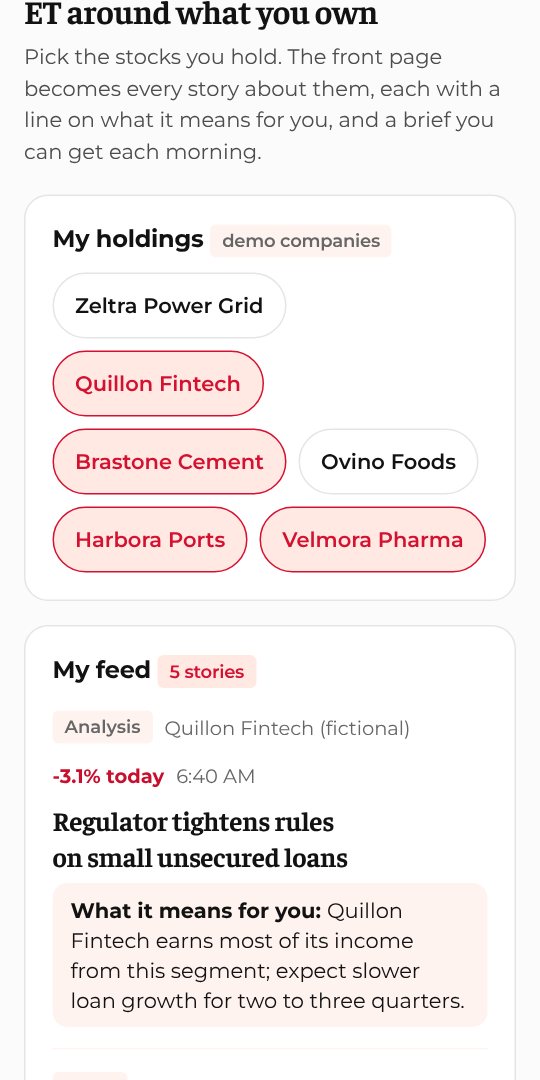
The My Stocks screen in the working model: holdings picked, and a feed of stories about them
From the working model: the front page built from the stocks a member holds. Try it in the working model →
Big bet 2 · combines I1, I3, I12

Renew by value: member mode, Investor Wrapped and pause

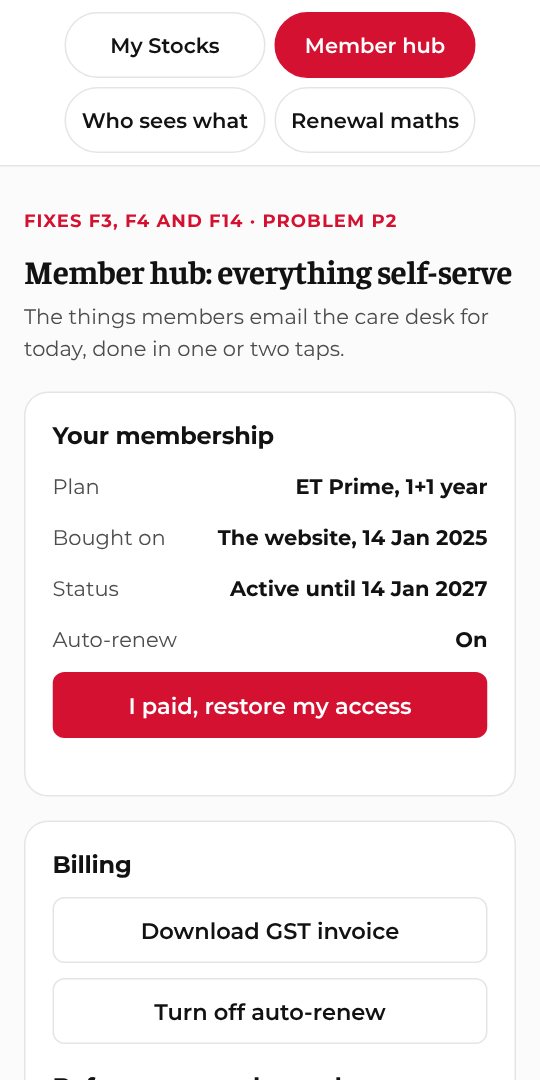
Up to 1 in 5 recent negative reviews of the ET app is about ads or upsells after paying. Renewal is where ET's subscription money is decided, and today the experience before renewal is the one most likely to make a member leave.

  1. From the day they pay, a member sees at most one ad per story, no pop-ups and no sales calls.
  2. Each month, a value receipt: stories read, tools used, ads avoided.
  3. Before renewal, Investor Wrapped: the year in stocks followed and lessons learned, made to share.
  4. At renewal, "pause for a month" sits beside "cancel", one tap each.

Why ET can win this

ET already has the reading and tool data to make a recap personal, and a recap made to share carries ET's brand into the member's own network for free.

How it makes money

On public numbers, each one-point rise in the share of members who renew is worth up to about ₹47 lakh a year (the plan page shows the working), so the aim is five points, about ₹2.4 crore. Shared recaps bring new readers at no media cost.

Cheapest first test

Give member mode, the value receipt, Investor Wrapped and pause to half of the members renewing over two quarters; the other half keep today's experience. Compare renewal rates.

What could go wrong

Ad revenue from members falls; if members read five times as much as the average visitor, they are still under 3% of page views. Recaps leave out holdings unless the member chooses to share them. A recap of a quiet year can remind a member they hardly used ET: send it above a reading threshold, and a "here is what you missed" version to the rest.

Stop if: renewal in the half that got it is not at least two points higher than in the other half, over two quarters.

Sources: ET app reviews, Google Play · Crisil rating report, June 2025

The member hub in the working model: plan, status, auto-renew and a restore-access button
From the working model: the member hub, with restore, invoice and two-tap cancel. Try it in the working model →
Big bet 3 · combines I5, I6, I14

Ask ET: an answer engine, and an archive that earns

Google search referrals to publishers fell 40.2% in a year, while weekly use of AI chatbots for news rose from 7% to 10% in the countries surveyed. Readers increasingly ask rather than search, and decades of Indian business reporting are what those answers need.

  1. A reader asks, on ET or WhatsApp, "What did the RBI's last policy mean for home loans?"
  2. Ask ET answers in plain words, citing the ET stories it used, with their dates.
  3. Three answers a day are free; members get unlimited answers and the Prime pieces behind them.
  4. The same archive, licensed, earns from AI companies that want trusted Indian business news.

Why ET can win this

Answers grounded in one newsroom's reporting can cite and date every claim, which general chatbots struggle to do on Indian business detail.

How it makes money

Sign-ins and Prime starts from answer users, plus licensing. Abroad, News Corp's 2024 deal with OpenAI, covering current and archived content, was reported as possibly worth over $250 million across five years, for many titles, so a ceiling rather than a comparison.

Cheapest first test

Ask ET on 10% of article pages for six weeks, answering only from ET's own stories. Measure sign-ins, answer ratings and Prime starts from answers.

What could go wrong

Wrong answers damage trust: answer only from ET text, always cite, and say "I do not know" when the archive is silent. Licensing needs a rights check first, since wire, syndicated and partner content may not be ET's to license, and it can feed the tools that take readers away.

Stop if: fewer than 2% of answer users sign in, or editors checking a weekly sample find more than 1 answer in 50 wrong.

Sources: Chartbeat, search referrals (Android Headlines) · Reuters Institute Digital News Report 2026 · News Corp and OpenAI deal (PYMNTS)

Judgement

Tempting ideas I would not do, and why

  • Cut the price to ₹499 to match Moneycontrol. ET's subscription money at list price is already about the same as Moneycontrol Pro's. At ₹499, ET would need about 5.4 times its members just to keep the same money.
  • Rebuild the old portfolio tracker as it was. Holdings live at the broker. Asking readers to type them in again is the job brokers already won; importing the depository statement gives the same data and ties it to stories.
  • Put all markets news behind the paywall. Advertising is 65 to 70% of Times Internet's revenue and search traffic is falling. Locking up the free news that brings readers in shrinks both the ad base and next year's subscribers.
  • Run more "Buy 1, get 1 free" sales. Bonus-month bundles are already the default. More of them teach buyers to wait for the next sale, and lower the price at renewal.
  • Grow the sales team. Reviewers already report calls after paying or saying no. More calls make P1 worse; better targeting raises revenue per call.

The near-term work is on the fixes page; how I would sequence it and measure it is on the plan page.