The short version
1 · The problem
- A free eye test leaves a dated prescription on file.
- From public data, nothing tells the customer when to come back.
- A first-timer whose test found a power, but who did not buy, gets no follow-up I could find.
- This is about prescription updates, not style.
2 · Who it is for
- First-time testers: "more than half" of Lenskart's 70 lakh tests last quarter.
- Children, whose eyes change every year; reminders go to the parent.
- Not routine reminders for adults: most adults' distance prescriptions barely move until about 50, so adults get one only if they ask.
3 · What exists, what I would add
Live today
- Free and ₹99 home eye tests, saved prescriptions
- Free replacement lenses with a ₹199 fitting fee, Gold membership (1 crore members)
- Store booking, and calls to confirm lens power
I would add
- A follow-up for first-timers who did not buy
- A due date for each customer's next test
- A reminder for children and for adults who ask
4 · The numbers, with caveats
- The follow-up pays for its messages if it adds 1 order for every 470 or so people messaged, measured against a holdout.
- My scenario: about ₹2.9 cr a year after running costs (₹4.9 cr of contribution), in a range from ₹0.4 cr to ₹5.5 cr. Every lift in it is unproven.
- Lenskart may already have tried this. Only a test against a holdout would tell.
People Lenskart has already tested get no prompt to come back for their eyes
What I am trying to solve
- For Lenskart, not for the market. Bring back customers Lenskart has already tested, when their eyes have probably changed. More eye tests across India would be a side effect, not the goal.
- Two moments. A first-time tester whose test found a power but who did not buy. And a child, whose power changes every year, when the next test falls due.
- Prescription, not style. Style already has its triggers: new collections, Gold's second pair, and the examples of a trigger Lenskart's CEO gives are collections. The prescription date is the clock I could not see anyone using.
Fair questions, and my honest answers
- The eye test is free. If nothing changed, will they buy?
- Mostly not, and that is the weak point. I assume 40% of re-tests find no change and sell nothing; those customers are told to keep their pair. That is why most of the value sits with first-timers, not with reminders.
- Won't customers come back anyway?
- Many will. Customers Lenskart acquired in FY23 bought 3.6 eyeglasses within two years. The idea only matters for the ones who do not, and public data does not say how many that is.
- Customers only open the app when they need glasses.
- Agreed, so the app cannot be the channel. The first touch is WhatsApp, and the one that worked best in published trials is a phone call. Lenskart has called customers to confirm lens power since at least 2017 (slide 06).
Eyes change fastest in childhood; adults' distance prescriptions barely move until about 50, and reading power arrives from about 40
| Age | How the prescription changes | Suggested re-test | In this idea |
|---|---|---|---|
| Under 18 | Myopia grows by about 0.5 dioptre a year, faster in younger children; it stops in half of myopic children by 15 and three quarters by 18 (US National Academies, 2024) | Every year; every 6 months on myopia control | Focus: reminder to the parent |
| 18 to 39 | Mostly stable; refraction holds from early adulthood to about 50 (Tehran Eye Study) | About every 2 years | Only if they ask. First-timers get the follow-up |
| 40 to 59 | Reading power arrives and grows through the 40s and 50s (presbyopia) | About every 2 years | Only if they ask |
| 60 and above | More settled; later shifts are driven mainly by cataract, a doctor's question more than a glasses one (Beaver Dam Eye Study) | Every year from 65 | Not the focus |
How often people should get tested
- UK College of Optometrists: without a clinical reason, do not recall adults more often than every two years.
- Common US guidance: yearly for children, every two years for most adults, yearly from 65.
- I found no official interval in India.
How often they actually do
- Rural Tamil Nadu: 15.5% of adults had ever had an eye examination (TREE study, 2019 to 2020).
- United States: 17 months between exams on average (The Vision Council, 2023).
- I found no national figure for India.
How often people buy glasses
- Lenskart's FY23 customers: 3.6 eyeglasses within two years (Lenskart, disclosed).
- The India average: 1.8 eyeglasses in two years (Lenskart's FY26 annual report, beside its own 3.6).
What this means. A prescription does not change every year for most adults, so a yearly or two-yearly reminder to every adult would mostly find no change. Lenskart's own customers already buy 3.6 eyeglasses within two years, far more often than adult prescriptions change. The prescription clock matters most for children and for people tested for the first time.
What Lenskart already runs, and what I could not find
Checked on 13 and 14 Nov 2026, logged out: Lenskart's India store locator and a store page, the Lenskart at Home page, Lenskart's India FAQ and terms page, the public catalogue data its web app loads, aqualens.in and six Lenskart apps on Google Play and the App Store, plus Lenskart's own filings. Nothing was purchased and no forms were submitted.
One limit, stated plainly: from the network this audit ran on, Lenskart's rendered India home, product and Gold pages redirected to its US storefront. I read their content from Lenskart's India FAQ page and public catalogue data instead, and I have not seen the logged-in app.
Takeaway. The pieces exist: free and home eye tests, saved prescriptions, free replacement lenses, Gold and calls. I found nothing public that connects a test date to a next step.
22 capabilities checked
12 live, 4 partial, 6 not found in public.
The 6 I could not find
- Reminder that the next eye test is due
- Prescription age shown to the customer
- Follow-up after a test with no purchase
- Scheduled re-test for children
- Trade-in or upgrade for an old pair, India
- One layer linking the test date to an action
Five possible gaps, as far as public evidence shows
Takeaway. Customers rate the app well, the power reading is the fragile part, and none of 3,500 reviews mentions being told a test was due.
App ratings, read on 14 Nov 2026
| Store | Rating | Ratings | 1 or 2 stars |
|---|---|---|---|
| Google Play | 4.5 | 7,92,550 | 7.6% |
| App Store, India | 4.5 | 1,07,856 | 9.0% |
Google Play shows its star split as percentages (1★ 6.5%, 2★ 1.1%); the App Store gives counts (8,714 one-star and 989 two-star). Google Play lists 5 crore+ downloads for this one app; Lenskart reports 12 crore+ app downloads in India across its apps.
What that suggests
- About 9 in 10 people who rate the app give it 3 stars or more, so a reminder would mostly reach satisfied customers.
- Under 2% of Google Play installs leave a rating at all. Most people open the app only when they need glasses, so the app cannot carry a reminder on its own.
- The low ratings are mostly about delivery, support and refunds, but the one that matters here is a wrong power: a reminder that leads to a bad re-test does harm.
In customers' own words
- Read: 3,500 public reviews, the latest 3,000 on Google Play (28 Aug to 12 Nov 2026) and 500 on the App Store (29 Apr to 11 Nov 2026), collected 13 Nov 2026.
- Low ratings (1,458 at 1 to 3★), by keyword: delivery 243, customer support 235, refunds, returns or exchanges 220, power, lens or product quality 148 (33 a wrong or different power). A review can match more than one.
- Caveat: keyword counts are blunt, and written reviews skew negative against a 4.5 rating. Quotes are verbatim; names left out.
"I have tried to get power checked three times in 2 weeks and every time they have given me a different power."
"The service was very professional, they identified that my eye glasses number is increased."
"We have 2 gold memberships in my family but have found that the non user or new user have better offers."
"Gold membership with all India validity 2 yrs but struggling to lens replacement order place since last 2 months."
"had booked an in-home eye test and the person arrived within 30 minutes and took his good time to do a proper eye test and show me some good frames."
"I have been a loyal Lenskart customer for over five years, and my recent experiences have been consistently disappointing."
What this says: the eye test is what customers trust or distrust most, so a recall has to protect the power reading before it sells anything; returning customers notice when a new customer gets a better deal; and nobody in 3,500 reviews mentions being told their next test was due.
| Shortcoming | Evidence | So what |
|---|---|---|
| 1. I could not find an owner for the second eye test | 2.07 crore India tests in FY26, each leaving a dated, saved prescription. No reminder, recall or prescription-age message is public. The CEO's examples of a trigger are collections, such as a wedding range that "ran out of stock very fast". | From what is public, the triggers are fashion-led; I found no clinical one. The logged-in app could differ. |
| 2. Churn is acknowledged, not measured in public | "Consumers do churn." The disclosed "2-year repeat rate ... about 98%" is repeat orders divided by first orders, not the share of customers who return. No retention or churn rate is disclosed. | Heavy buyers can hide the people who never come back. |
| 3. First-timers buy slowly, and nobody follows up | India eye tests +54.3% in FY26 against customer accounts +24.2%. Management says a significant majority of tested people buy and first-timers take longer, and names the fix: "better CRM to bring these people into the fold" (Q1 FY27 call). | Management expects the gap. The open question is who follows up with the slow ones. |
| 4. Gold's clock is the renewal date, not the prescription date | Gold "was designed many years back to address" churn. It is "a second pair, lens upgrades, exclusive offers", and management plans to add "eye-care benefits and services on the app". 83 reviews mention Gold or membership; 71 of them are 1★. | The fee already covers a free home eye test; nothing I found tells a member when to use it. |
| 5. Trust in the power reading is fragile | 33 low-rated reviews mention a wrong or different power or lens, and 148 mention power, lens or product quality more broadly. One describes three tests in two weeks with a different power each time. | A recall that leads to a wrong pair does more harm than no recall. |
Why Lenskart probably isn't running a recall, and is probably right for most customers
My read. Lenskart describes the eye test as how it wins new customers. A routine re-test of a settled adult usually finds nothing to sell, and it takes an optometrist slot a new customer could have had. On public evidence, leaving it out looks like a deliberate and sensible choice, not an oversight.
| Reason | Public evidence | What I changed because of it |
|---|---|---|
| 1. The eye test is for acquisition | "Our mandate is to accelerate new customer acquisition" and "Every eye test expands the addressable market itself" (Q4 FY26 shareholders' letter). 2.38 crore tests in FY26, about half of them first-time in India. | Lead with the First Prescription Follow-up. Following up a first-timer is acquisition, and it needs no second test. |
| 2. Most adults' eyes don't change | Refraction stays stable from early adulthood to about 50 (Tehran Eye Study). Children's myopia grows by about 0.5 dioptre a year, and stops in half of them by 15 and three quarters by 18 (US National Academies, 2024). | No routine reminder for adults unless they ask for one at the test. Children's reminders go to the parent. |
| 3. Optometrist time is the bottleneck | Lenskart calls the optometrist one of "the scarcest skills in eyewear", and India eye tests grew 44.1% last quarter. | Re-tests are booked into open slots only, never a first-timer's. |
| 4. A re-test often ends in lenses, not a new frame | The CEO says customers lack "triggers to buy more eyewear" and gives collections as the example. Replacement lenses are free with a ₹199 fitting fee, against a ₹1,950 selling price, and Lenskart says the free lens replacement "depressed Q4 FY25 ASP to ₹1,609" from about ₹1,760 (Q4 FY26 letter). | The lens-swap loss is a line in my sizing. On its own the adult reminder loses money, so it is the last thing to test. |
| 5. Customers already come back | Customers acquired in FY23 bought 3.6 eyeglasses within two years. | Expect a small lift, and read it only against a holdout. |
| 6. Call rules tightened in 2025 | Since TRAI's February 2025 amendment, promotional calls must come from 140-series numbers and service calls from 1600-series; ordinary 10-digit numbers cannot be used. The DPDP Act needs clear, withdrawable consent. | Calls only from Lenskart's registered service line, only to people who agreed at the test. No store-phone calls. |
| 7. The capability already exists | Lenskart has called customers to confirm their lens power since at least 2017, from one registered number (Lenskart's Truecaller partnership announcement, May 2017, quoting Peyush Bansal). Stores have their own numbers behind an IVR. | So the absence looks like a choice. My first question would be whether a reminder call was ever tested, and what it showed. |
What survives
- First-timers whose test found a power and who did not order
- Children, through a parent
- Adults who ask for a reminder
What I dropped
- A routine reminder to every adult
- Store-phone calls
- Re-tests in peak slots
What I cannot see
- Whether Lenskart has tested any of this
- How many tested first-timers leave without ordering
- When customers actually return
How might we turn every eye test into the next one?
Constraint: no extra discounting and no new store formats. Seven options across acquisition, conversion, retention and upgrade, sorted by impact (my estimates).
Takeaway. Three of the seven options run on the same data, the eye-test record and its date, so they combine into one product.
| AI bet | What it does | Revenue lever | Builds on | Impact | Effort |
|---|---|---|---|---|---|
| Recall on the prescription date | Due date → re-test → right next step | Repeat, lens upgrade | Saved prescriptions, Gold, store booking | High | Med |
| Self-service eye test at scale | More tests per optometrist | New customers | Lenskart's Drysh pilot | High | In build |
| First Prescription Follow-up | Two messages with the saved power, then stop | Conversion | First-ever eye tests | High | Low |
| Recall Reminder on WhatsApp | A due-date message with a slot, no offer | Repeat, trust | Store booking, home eye test | Med | Low |
| Kids' myopia tracker | A power chart for parents | Kids' lenses, family | Kids' eye test, myopia-control lenses | Med | Med |
| Contact lens run-out reorder | Reorder prompt timed to the pack | Repeat frequency | Aqualens | Med | Low |
| Old-pair trade-in at re-test | Credit for an old frame | Order value | Free Lens Replacement | Low | Med |
Recall is standard practice elsewhere
The UK College of Optometrists tells its members not to recall adults more often than every two years without a clinical reason. I found no such norm in India.
Reminders work, by very different amounts
In US eye clinics, an automated call with a letter lifted follow-up from 28% to 30% and a personal call with a letter to 38% (Callinan et al., 2017); a brochure, a personal letter and a call lifted completed exams from 30% to 48% (Zangalli et al., 2016). In China, two informational text messages before a booked diabetic eye visit lifted attendance from 14.0% to 42.9% (Chen et al., 2018). All are clinics, not shops.
A rival already does it
Titan's Encircle programme: "You can opt for a reminder for an eye test and contact lens refill every 6 months". Titan Eye+ recommends "an eye-test every six months". Titan already offers one, on a single six-month rhythm.
The Eye Test Follow-up Engine: six features to test on what Lenskart already runs, starting with the First Prescription Follow-up
Narrowed by slide 06. It reads the eye-test record Lenskart already holds, follows up people whose first test found a power, reminds parents of children and adults who ask, and suggests lenses or a pair only after a test says one is needed. Each link opens that feature in the prototype.
Two messages in 30 days to someone whose first eye test found a power and who has not ordered: their saved power and two ways to try frames. Then it stops.
For: first-time customersSee Ravi's follow-upWhen each customer's next eye test is due, from the date of their last test and their age band. Shown to everyone in the app; a message goes only to parents of children and to adults who asked.
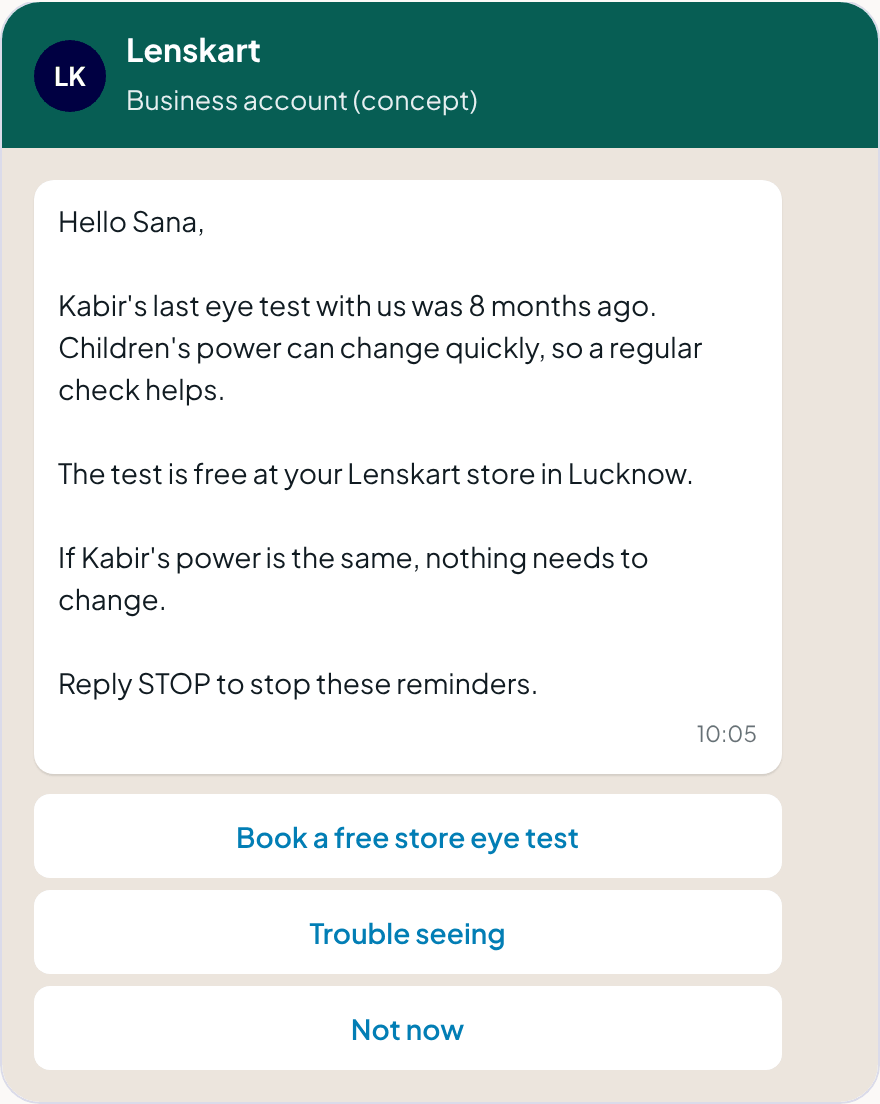
For: the CRM teamSee the Recall DateOne short WhatsApp message when a test falls due: to the parent for under-18s, and to adults only if they asked at their test. A slot to book, no price or discount.
For: the wearer or the parentOpen the Recall ReminderThe eye test booked in two taps into an open optometrist slot, never a first-timer's. If an overdue customer has not booked by day 8, one call from Lenskart's registered service line, only if they agreed.
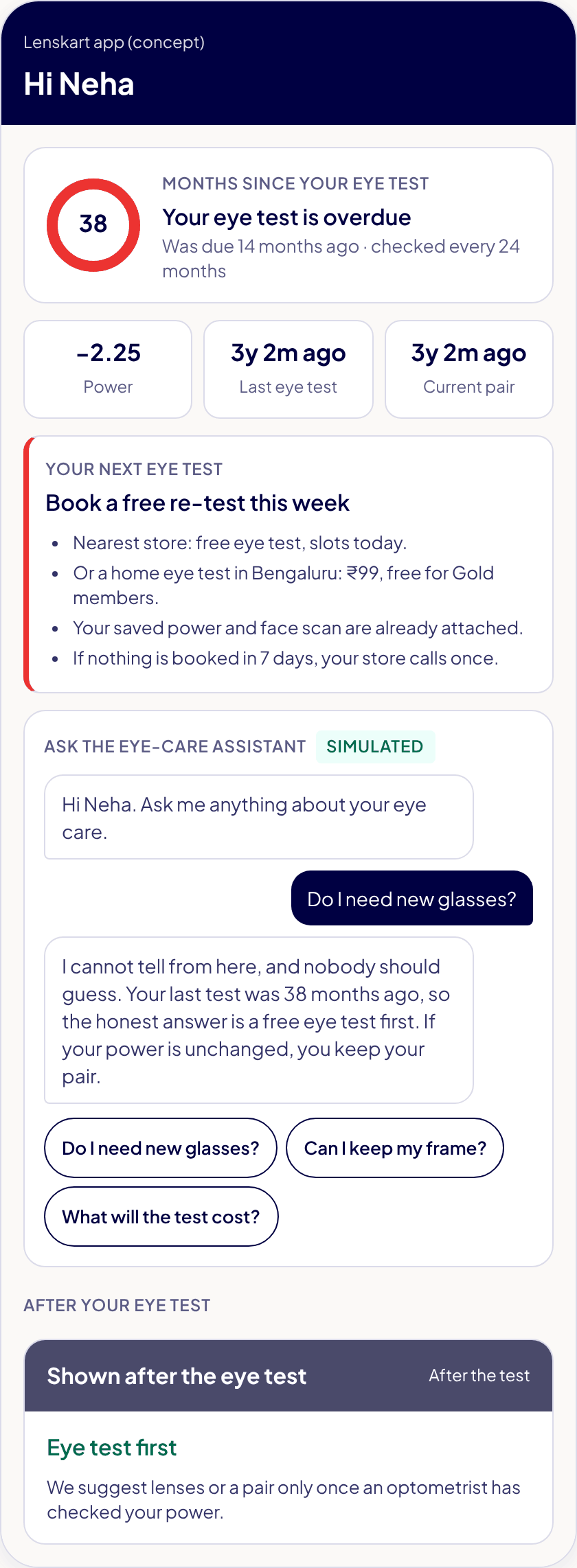
For: the customer and the storeSee Neha's bookingWhat follows the test, set by its result: keep your pair if the power is unchanged, new lenses in your current frame if it changed, a referral if glasses are not the answer.
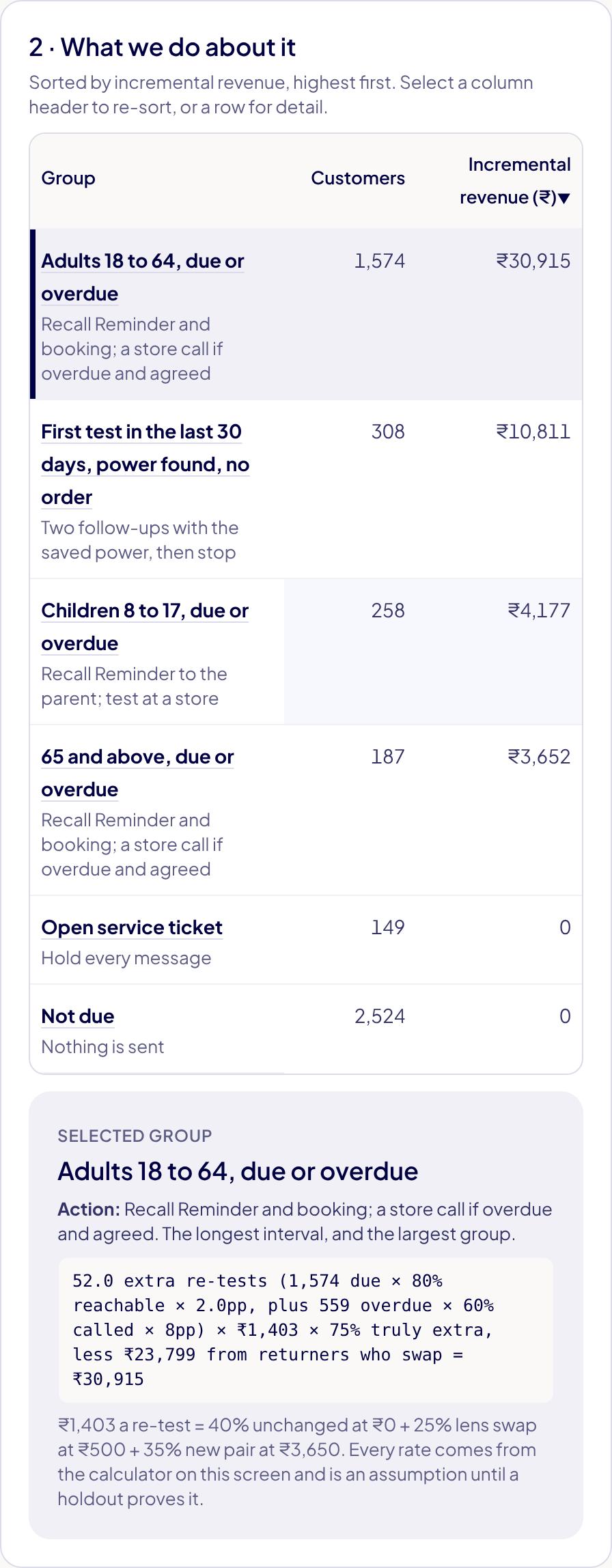
For: the customerSee the outcomeThe CRM team's weekly screen: each group, the action it gets, its holdout, and results against the holdout once a pilot runs.
For: the CRM teamOpen the dashboardWhat pays first. On my numbers the First Prescription Follow-up earns all of it and more: about ₹3.8 cr, against ₹2.9 cr net overall. The call in Recall Booking roughly breaks even, at about ₹0.1 cr. The Recall Reminder on its own loses about ₹0.2 cr, because offering the cheaper lens swap first costs some returners a new pair. On these numbers I would test the follow-up first and the reminder last. See the sizing
Reuses (already live)
- The saved prescription and its date, from 2.07 crore India tests a year
- Store appointment booking and the ₹99 home eye test
- Free Lens Replacement and the lens packages
- Lenskart Gold and the face-scan profile
- The in-house CRM, and the registered number Lenskart already uses to call customers about their lens power
Adds (not found today)
- A due date for every customer's next eye test, shown in the app
- A reminder for children's parents and adults who ask, with no price
- One consented call from the service line when an overdue customer has not booked
- Booking into open optometrist slots only
- A next step that depends on the re-test result
- A follow-up for first-time tests with no order
- A holdout to prove incremental lift
Where the AI is
- The due date is a rule, on purpose: it has to be explainable to a customer and owned by optometry.
- A model ranks who is most likely to act, to order the call list.
- Language models draft each reminder in the customer's language and answer questions, inside fixed rules: no price, no diagnosis.
What I would not build
- No discount in any recall message.
- No AI-read power; the optometrist decides.
- No message to a child; it goes to the parent.
- No contact-lens reorder or trade-in in the first release.
- No routine reminder to adults who did not ask.
- No calls from store phones; one call, from the service line.
Who owns it
- CRM owns the engine and the holdout.
- Optometry owns the intervals and the symptom rules.
- Customer service owns the day-8 call list.
- Legal owns consent and the children's flow.
Recall Reminder: who receives it, and how often
| Wearer | Re-test rhythm | Reminder goes to |
|---|---|---|
| Under 18 | Every 12 months; every 6 months for a child on myopia-control lenses | The parent who holds the account, with consent at the eye test (India's data protection law, the DPDP Act 2023, requires verifiable parental consent for under-18s) |
| 18 to 64 | Every 24 months, sooner if they report trouble seeing | The wearer, only if they asked at the eye test |
| 65 and above | Every 12 months | The wearer, only if they asked; a family member gets a copy only if the wearer opts in |
Intervals follow published guidance: the American Optometric Association (yearly from 6 to 17, at least every two years from 18 to 64, yearly from 65), the UK College of Optometrists (no routine recall more often than every two years from 16) and the International Myopia Institute (six-monthly follow-up for children on myopia control). Lenskart's optometry team would set the final ones. India has no legal prescription expiry, so the due date would be Lenskart's own clinical claim.
Try it: all six features, working
Six sample customers (Neha 29, Arjun 34, Kabir 9, Meera 47, Usha 68, and Ravi 26 after his first eye test). Change the signals and the test result and watch the Recall Date, the booking, the reminder and the outcome change. The Recall Dashboard groups a made-up cohort of 5,000 customers by the action each gets; the sizing model is a separate tab.
What has to be true: the follow-up pays for its messages if it adds 1 order for every 470 or so people messaged
Two parts. First, the break-even lift for each action: the smallest lift at which it pays for itself, which needs no assumed lift. Second, a scenario, which needs lifts nobody outside Lenskart knows. Every figure here comes from the sizing model in the prototype, and every assumption is editable there.
1 · Break-even: the smallest lift at which each action pays for itself
| Action | Break-even lift | In plain terms |
|---|---|---|
| First Prescription Follow-up 2 messages at ₹0.8631; a first order of ₹1,950, 75% truly extra, at 56% contribution | +0.21pp | 1 extra order for every 474 people messaged, against a holdout |
| Recall Reminder 2 messages and the lens-swap loss; a re-test worth ₹808, 75% truly extra, less its ₹108 cost | +2.85pp | 1 extra re-test for every 35 people messaged. The trial evidence suggests about +2, which is why it loses money |
| Call in Recall Booking ₹15 a call; the same re-test | +6.49pp | 1 extra re-test for every 15 calls, against about +8 in the trial, so it barely pays |
Each threshold solves the same equation as that action's line in "Which lever earns it" below, so the two always agree. ₹1,950 and 64.0% product margin are Lenskart's Q2 FY27 India figures and ₹0.8631 is Meta's published rate; the 8% selling cost and the 75% truly extra share are my assumptions. The re-test value also rests on my assumed outcome mix, so the follow-up line is the most solid of the three.
2 · A scenario, not a forecast
| Lever (India, a year) | Low | Base | High |
|---|---|---|---|
| Recall: re-tests that would not have happened 9.9M customers × 40% due × 30% who asked = 1.19M. (1.19M × +1 / 2 / 3pp, plus 213,840 calls × +4 / 8 / 12pp) × ₹808 a re-test × 75% truly extra | 1.2 | 2.5 | 3.7 |
| First Prescription Follow-up 1 cr first-ever tests × 70% power found × 30% no order × 80% reachable × +1.5 / 3 / 4.5pp orders × ₹1,950 × 75% | 3.7 | 7.4 | 11.1 |
| Returners who now swap lenses instead of buying a pair 1.19M × 20% who would return anyway × 3% × ₹1,450 less each | −1.0 | −1.0 | −1.0 |
| Extra revenue (₹ cr a year) | 3.9 | 8.8 | 13.7 |
| Contribution at 56% 64.0% India product margin less 8% variable selling cost | 2.2 | 4.9 | 7.7 |
| Less running costs WhatsApp, extra re-tests, calls, AI | −1.77 | −2.00 | −2.22 |
| Net of running costs (₹ cr a year) | 0.4 | 2.9 | 5.5 |
| Net in US$ at ₹94.24 | 0.04M | 0.31M | 0.58M |
Where each input comes from
- Lenskart-disclosed: 9.9M India transacting accounts in FY25, "over 1 Cr first-ever tests in FY26", ₹1,950 selling price and 64.0% product margin in Q2 FY27, 1.87 units per customer.
- My assumptions, each editable: 40% due in the year; 30% of due customers asking for a reminder; 70% of first tests finding a power; 30% of those not ordering within 30 days; 80% of first-timers reachable on WhatsApp; 75% of the lift truly extra; a re-test ending 40% unchanged, 25% in a lens swap worth ₹500 and 35% in a new pair at one pair's ₹1,950; 20% of due customers returning anyway and 3% of them swapping instead of buying; 12% overdue and 60% of those unbooked by day 8; and every lift.
- Base years: FY25 customers are the ones whose next test falls due now; first-timers and the accounts scored are FY26.
- Where the recall lifts come from: one US eye-clinic trial, where an automated call with a letter added 2 points and a personal call with a letter 10 (Callinan et al., 2017). Clinics, not shops; I stay near the bottom of the published range. The first-timer lift has no published benchmark at all.
- Not counted: anything after the first order, build cost, and the optometrist time a re-test uses. Figures are rounded; totals use unrounded values.
Which lever earns it
| Base case, after each lever's own costs | ₹ cr a year |
|---|---|
| First Prescription Follow-up The largest, and the one with no published benchmark behind its lift | 3.8 |
| Call in Recall Booking Roughly breaks even: it needs +6.5 points, and the trial found about +8 | 0.1 |
| Recall Reminder Loses money once the lens-swap loss is counted | −0.2 |
| AI ranking and drafting A cost shared by all three | −0.7 |
| Net of running costs | 2.9 |
What moves the answer most
| One input changed, the rest at base | Worse | Base | Better |
|---|---|---|---|
| Revenue from a first-timer's order ₹500 (Hustlr Club) / ₹1,950 (one pair) / ₹3,650 | −0.1 | 2.9 | 6.5 |
| Extra first-timers who order +1.5 / 3 / 4.5pp | 0.9 | 2.9 | 5.0 |
| First-timers with a power who do not order in 30 days 15% / 30% / 45%; Lenskart knows this number | 1.0 | 2.9 | 4.9 |
| Truly extra, not just earlier 50% / 75% / 100% | 1.1 | 2.9 | 4.8 |
| First tests that find a power 50% / 70% / 85% | 1.8 | 2.9 | 3.8 |
| First-timers reachable on WhatsApp 60% / 80% / 95% | 2.0 | 2.9 | 3.7 |
| Returners who swap instead of buying 6% / 3% / 0% | 2.4 | 2.9 | 3.5 |
| Extra who re-test after the message +1 / 2 / 3pp | 2.7 | 2.9 | 3.2 |
| Extra again after the call +4 / 8 / 12pp | 2.7 | 2.9 | 3.1 |
| Due customers who ask for a reminder 50% / 30% / 15%; fewer is better, because the reminder loses money | 2.8 | 2.9 | 3.0 |
Net of running costs, ₹ cr a year. Almost everything rides on the first-timer: what their order is worth, how many more a follow-up brings back, and how many leave without ordering. More adults asking for a reminder lowers the net slightly, because the reminder loses money; so does more customers falling due (₹3.0 cr at 25% due, ₹2.8 cr at 60%). Valuing a returner's new pair at 1.87 units a quarter (₹3,650) instead of one pair adds ₹0.4 cr.
What it costs to run
| Cost | Volume and rate | ₹ cr a year |
|---|---|---|
| Recall Reminders | 1.19M due customers who asked × 2 messages = 2.4M × ₹0.8631 | 0.21 |
| Prescription follow-ups | 1.68M first-timers with a power and no order × 2 messages = 3.4M × ₹0.8631 | 0.29 |
| Extra re-tests | 40,867 re-tests: 80% in store at ₹60 of optometrist time, 20% at home at ₹300 a visit | 0.44 |
| Calls on day 8 | 9.9M × 12% overdue × 30% who asked × 60% unbooked and agreed = 213,840 calls × ₹15 for a 3-minute call | 0.32 |
| AI ranking and messages | 12.3M accounts × ₹0.6 a year | 0.74 |
| Total running cost | Return on running cost: about 2.5x at base, about 1.2x at low | 2.00 |
The re-test, call and AI costs and all the shares are my estimates. 213,840 calls a year across 2,868 India stores is under two calls a store a week.
If it is worth testing: prove lift in two groups first
- Ask first: has Lenskart tested a reminder or a follow-up before, and what did it show?
- Measure how many tested first-timers leave without ordering, and when they come back
- Backtest: does prescription age predict the next order?
- Legal review of consent, and the service-line set-up for calls
- First Prescription Follow-up in Tier 2+ stores (smaller cities), 50/50 by customer, with a call from the testing store in place of message 2 as a third arm
- A "remind me" question at the eye test, to measure how many adults and parents say yes
- Re-tests only in open slots, capped at 5% of a store's weekly tests
- Children's reminders to parents, after legal sign-off
- Adult reminders and the call, last, and only if the follow-up works
- First read-out at 60 days; the extra-or-earlier question at 180
- Scale decision; 90/10 holdout at scale
Incremental revenue per due customer against the holdout at 60 days.
Delivered rate, reminder to booking, show-up rate, re-tests within 30 days of the due date, lens-swap share.
WhatsApp opt-outs and blocks, NPS (Lenskart's customer satisfaction score), wrong-power tickets, return rate, optometrist slots used.
Sample size
To detect a 1 point lift on an assumed 6% 60-day order rate, at 80% power and 5% significance, an arm needs about 9,500 customers; that fits the follow-up. The reminder alone implies about half a point, which needs about 37,000 in each arm. Both are sized on order rate; the revenue metric and the store-randomised arm need more, set from the baseline variance measured in weeks 1 to 3.
Data it needs
Test date and result, age band, order history, consent flags, ticket status. Events: reminder sent, delivered, booked, attended, result, order.
Riskiest assumptions, and the cheapest test for each
Takeaway. The riskiest assumption is that a due date brings anyone back at all. Past data can test that before anything is built.
A due date brings people back
Cheapest test: backtest return timing against prescription age, before building anything.
The re-test is trusted
Cheapest test: a second optometrist confirms any change above 0.5; track wrong-power tickets.
It does not cut order value
Cheapest test: read revenue per recalled customer against the holdout, not orders.
Review this case study in 7 steps, about 8 minutes
Each step is a complete link that opens the right screen, so any step can be shared on its own.
- The proposed system · 1 minThe six features, from the First Prescription Follow-up to the Recall Dashboard, and what they are worth.https://anchit-tandon.com/lenskart-study#system
- Customer app: Recall Date, Recall Booking, Recall Outcome · 2 minPick a customer and change the signals; the Recall Date, the booking and the outcome change with them.https://anchit-tandon.com/lenskart-study/prototype#customer
- Recall Reminder · 1 minSwitch between Kabir (9) and Neha (29) to see who receives it, in English or Hindi.https://anchit-tandon.com/lenskart-study/prototype#checkin
- Recall Dashboard · 1 minThe CRM team's screen: each group, the action it gets and its holdout. The sizing model is a separate tab.https://anchit-tandon.com/lenskart-study/prototype#console
- The evidence: live platform audit · 1 minWhat Lenskart runs today, and what I could not find.https://anchit-tandon.com/lenskart-study#audit
- Sizing, sensitivity and running costs · 1 minLow, base and high cases, what moves the answer most, and what it costs to run.https://anchit-tandon.com/lenskart-study#impact
- Why me · 1 minWhere I have run this playbook before, and how to reach me.https://anchit-tandon.com/lenskart-study#me
I have run this playbook on a paid subscription product
Times Internet, June 2022 to April 2026: Associate PM → PM → Senior PM.
Engineer turned PM (B.Tech CSE, VIT). I prototype with AI myself, as with this case study and its working prototype, so ideas reach users and data faster.
Appendix
Lenskart's public numbers, for reference
Background from Lenskart's shareholders' letters, earnings calls and prospectus. Included so every figure above can be checked, not as an explanation of Lenskart's business.
Reference data from Lenskart's own filings
FY26 (year to 31 March 2026), on the proforma basis Lenskart reports, from its Q4 FY26 shareholders' letter. Trailing twelve months to September 2026: revenue above ₹10,000 cr. EBITDA is operating profit before depreciation, PAT is profit after tax, YoY is year on year.
FY26 revenue mix (₹9,002 cr)
Shares are of consolidated revenue; the two segments add up to slightly more than it. Prescription eyeglasses were more than 80% of revenue in each of FY23 to FY25 (prospectus).
Unit economics, India
1.23 crore customer accounts transacted in India in FY26. One order is worth about ₹3,650 (1.87 units at ₹1,950). In Q2 FY27, 57% of India sales were digitally influenced.
From eye test to repeat purchase: the public numbers at each step
App downloads in India; 2,868 stores in 665 cities
India eye tests in FY26, about half first-time
India customer accounts that transacted in FY26
Active Gold members: ₹500 a year for a second pair and offers
Eyeglasses bought within two years by customers acquired in FY23
The step with no public number is the last one: the same person coming back for their next eye test. Lenskart's CEO says "consumers do churn", that Gold "was designed many years back to address this", and that "today consumers do not have enough triggers to buy more eyewear" (Q3 FY26 call). Gold's clock is the renewal date. This study is about the other clock, the prescription date.
Lenskart's eye tests are growing faster than its customer base
Lenskart India, FY26 growth year on year
These are Lenskart's own figures, not the Indian market's. The same gap held in Q2 FY27: India eye tests +44.1%, transacting customer accounts +18.5%. Management says a "significant majority of people who do an eye test end up buying glasses", and that first-timers "take slightly longer" (Q1 FY27 call). So the gap is mostly market creation, not a leak. It also means every test leaves a dated prescription on file, and a next test that someone has to win.
Lenskart, Q2 FY27, year on year (sorted by growth)
| Driver | Metric | Growth |
|---|---|---|
| Remote optometry | Stores, 303 → 934 | 3.1x |
| Gold | Subscription fees, ₹73 cr | +54.6% |
| Eye tests, India | 70 lakh in the quarter | +44.1% |
| Gold | Active members, 103 lakh | +38.6% |
| International | Revenue, ₹1,201 cr | +29.5% |
| Stores, India | Same-store sales | +20.8% |
| India | Revenue, ₹1,668 cr | +35.3% |
Q2 FY27 revenue ₹2,845 cr, +32.5%; PAT ₹232 cr. Source: Q2 FY27 shareholders' letter.
Each figure, its source, and whether it is Lenskart's or mine
Checked against the primary documents on 14 Nov 2026. Anything marked "Assumption" is mine, editable in the sizing model, and unproven until a pilot measures it.
| Figure | Value | Source | Type |
|---|---|---|---|
| India eye tests, FY26 | 2.07 crore, +54.3% | Lenskart FY26 Annual Report | Disclosed |
| Share first-time | About half (FY26); more than half (Q2 FY27) | Q4 FY26 and Q2 FY27 shareholders' letters | Disclosed |
| First-ever tests, FY26 | Over 1 crore | Q1 FY27 shareholders' letter | Disclosed |
| India eye tests, Q2 FY27 | 70 lakh, +44.1% | Q2 FY27 shareholders' letter | Disclosed |
| India selling price, product margin | ₹1,950; 64.0% | Q2 FY27 shareholders' letter | Disclosed |
| Units per transacting customer | 1.87 | Q1 FY27 shareholders' letter | Disclosed |
| India transacting accounts | 9.9M (FY25), 12.3M (FY26) | FY26 Annual Report | Disclosed |
| Eyeglasses in two years | 3.6 (FY23 cohort) vs 1.8 India average | FY26 Annual Report | Disclosed |
| Selling price when lens replacement launched | About ₹1,760 to ₹1,609 | Q4 FY26 shareholders' letter | Disclosed |
| Gold members | 103 lakh at 30 Sep 2026, +38.6% | Q2 FY27 shareholders' letter | Disclosed |
| WhatsApp marketing message, India | ₹0.8631 | Meta's INR rate card, effective 1 Oct 2026 | Published rate |
| ₹ per US$ | 94.24 | ECB reference rates, 13 Nov 2026 (cross rate) | Published rate |
| App ratings | 4.5 from 7,92,550 (Play); 4.5 from 1,07,856 (App Store) | The two store pages, 14 Nov 2026 | Observed |
| Reminder lifts in clinics | +2 and +10 points | Callinan et al., 2017 | Published study |
| Myopia progression in children | About 0.5 dioptre a year | US National Academies, 2024 | Published study |
| 40% due, 30% opt-in, 70% power found, 30% no order, 80% reachable, 75% truly extra, the re-test outcome mix, ₹500 lens swap, 20% return anyway, 3% swap instead, 12% overdue, 60% unbooked, 8% selling cost, ₹15 a call, ₹60 and ₹300 a re-test, ₹0.6 of AI an account, and every lift | See the sizing model | Mine | Assumption |
All 22 capabilities, with the evidence for each
| Capability | Status | What I saw (verbatim where quoted) | Where |
|---|---|---|---|
| Free eye test in store, bookable | Live | "Get free eye test & eye checkup by trained optometrist and eye specialist"; every store card has "Book Free Appointment". | lenskart.com/stores |
| Home eye test | Live | "The test costs ₹99 and is free for Gold members."; 18 cities; "12 Step Eye Checkup"; "book an eye-test for up to 4 family members in a single appointment"; "Required age for eye test is 14 - 75 years". | Lenskart at Home page and its FAQ data |
| Remote optometry | Live | "Remote optometry, now in 934 stores, let us open 94 Tier 2+ stores this quarter". | Q2 FY27 letter |
| Kids' eye test in store | Live | For ages 8 and above in all India stores since January 2026; "~70% of kids we tested ... require vision correction". | Q3 FY26 call; Q1 FY27 letter |
| Face scan and 3D try-on | Live | "Lenskart Face Analysis - An AI powered tool that helps you select the perfect glasses to suit your face shape"; "3D Try On"; "Over 100,000 face scans daily". | Google Play and App Store listings; Annual Report |
| AI stylist and AI support | Live | B AI Stylist users are "nearly 3x more likely to make a purchase"; "Call Lenskart today and an AI voice assistant answers - no IVR, no queue"; an AI model "processes the majority of warranty decisions". | Annual Report; Q2 FY27 letter |
| Saved prescriptions | Live | The web app's text bundle, as served on the US storefront, carries "My Saved Prescriptions" and "Use Saved Power"; the prospectus says customers in India can review eye-test results from stores in the app. | lenskart.com web app text; prospectus |
| New lenses in an existing frame | Live | "Replacement is available in-store every day."; "Offer valid for Lenskart /Non-Lenskart products."; totals from ₹199 to ₹2,049 by lens; "Offer Valid for single use per user". | Lenskart India FAQ and terms; Annual Report |
| Paid membership | Live | Lenskart Gold, ₹500 for one year, 103 lakh active members: "a second pair, lens upgrades, exclusive offers". The FAQ says members can "share your registered mobile number" with family and friends; the Gold family pass adds "Share phone numbers of any 4 of your favourite people and they will get Gold Membership Benefits at no extra cost!" | Lenskart India FAQ and Gold catalogue data; Q2 FY27 letter |
| A ₹500 first pair | Live | Hustlr Club: "a face scan on the app, a colour, and a complete pair, frame, lenses and warranty, for ₹500". | Q2 FY27 letter |
| Returns | Live | 14 days on eyeglasses, and "a 45-day, no-questions-asked return or exchange policy ... on all progressive eyeglasses". | Lenskart India FAQ and terms |
| Free servicing in store | Live | Loose screws, misalignment, nose pads and loose fit are "attended to real time, at all Lenskart stores pan India (free of cost)". | Warranty policy |
| Self-service eye test | Partial | Drysh, an AI-assisted test: "you do most of it yourself, with an optometrist supervising"; "piloting ahead of a wider rollout". | Q2 FY27 letter |
| A family's eye care in one place | Partial | Gold benefits are shared by phone number and home tests cover up to 4 family members; in store, the face scan "lets us recognise an individual and their family members". I found no family view of test dates or powers. | Lenskart India FAQ; Q2 FY27 letter; Lenskart at Home |
| AI in customer messaging | Partial | "We have been investing a lot in AI based CRM and to make it more conversational"; CRM, the system that messages customers, was brought in-house this year, and "the customer relationship now runs on our own AI". What it sends is not public. | Q3 FY26 call; Q2 FY27 letter |
| Contact lens repeat orders | Partial | Aqualens Xclusive: "Order 3 times in 365 days & win a FREE pair". No subscription, auto-reorder or run-out reminder on the pages I reached. | aqualens.in |
| Reminder that the next eye test is due | Not found | Lenskart's FAQ describes notifications for "latest collections, exciting offers, store launches", not eye tests. The nearest thing is a static "6 Signs you need an eyetest" panel. In 3,500 app reviews, "remind" and "renew" appear zero times, and neither app's latest release notes (7 and 10 Nov 2026) mention one. A rival does: Titan's Encircle programme says "You can opt for a reminder for an eye test and contact lens refill every 6 months". | India FAQ, store locator, Lenskart at Home, both app listings, filings to 11 Nov 2026; titaneyeplus.com |
| Prescription age shown to the customer | Not found | Powers are saved, but I found no "your power is N months old" or validity message on any public page or in the web app's text. | Same pages; the logged-in app was not seen |
| Follow-up after a test with no purchase | Not found | Not publicly documented. The CEO names it as work to do: "we will have to use our engineering to see how do we do better CRM to bring these people into the fold". | Q1 FY27 call; Lenskart at Home |
| Scheduled re-test for children | Not found | Kids are tested and myopia-control lenses are sold, but I found no scheduled follow-up. For Children's Day on 14 Nov 2026, Lenskart offered free glasses to the first 1 lakh children aged 5 to 12, and news reports describe no re-check. The home test excludes under-14s. | Lenskart at Home; filings; Upstox, 12 Nov 2026 (news) |
| Trade-in or upgrade for an old pair, India | Not found | No trade-in, buyback or upgrade offer for an old pair in India. The annual report describes a frame trade-in donation programme in Singapore. | India FAQ, store locator, warranty policy, app listings |
| One layer linking the test date to an action | Not found | The test, the saved power, lens replacement, Gold and the store each exist; no public evidence of a due date that triggers a booking, a store call or a next step. | Internal systems not visible publicly |
Sorted Live → Partial → Not found. "Not found" means not publicly documented; logged-in experiences, push notifications and internal tools could differ.
All ten assumptions, why each could be wrong, and the cheapest test
| Assumption | Why it could be wrong | Cheapest test |
|---|---|---|
| A due date brings people back | They may already return on their own, when a pair breaks, a collection launches or Gold comes up for renewal; adult prescriptions rarely change | Backtest return timing against prescription age before building anything |
| The re-test is trusted | Reviews describe a different power at each test: "every time they have given me a different power" (Google Play, 7 Sep 2026) | In the pilot, a second optometrist confirms any change above 0.5; track wrong-power tickets per 1,000 re-tests |
| It does not cut order value | It has happened: the lens replacement offer took India selling price from about ₹1,760 to ₹1,609 in Q4 FY25, and units per customer dipped | It is in the sizing as a negative line. Track revenue per recalled customer against the holdout, not order count |
| Stores have optometrist time | Lenskart calls the optometrist one of "the scarcest skills in eyewear"; a re-test that ends in "keep your pair" can take a first-timer's slot | Book re-tests into open slots only; cap them at 5% of a store's weekly tests |
| The message arrives and is opened | Meta caps marketing messages per user by how many they read, with no fixed number, Lenskart's promotions use the same allowance, and one review says "the app sends too many notifications" | Measure the delivered rate in a 2-week pilot; one reminder and one follow-up reminder per due date; fall back to app push |
| The call is allowed and wanted | Since February 2025, TRAI's rules allow promotional calls only from 140-series numbers and service calls from 1600-series, not ordinary 10-digit phones | Call only from Lenskart's registered service line, only customers who agreed at the eye test; legal confirms the category |
| Old records can be used | Existing prescriptions were collected to make glasses, not to send reminders; a prescription is health data | A one-time notice with opt-out before the first reminder; every message says how to opt out (DPDP Act 2023) |
| Children can be included | Under-18s need a parent's verifiable consent, and the Act limits tracking of children | Fresh parental consent at the eye test; legal review before the children's flow goes live |
| Lift is incremental | A recall may only bring forward an order that was coming anyway | Keep a holdout for every action and read revenue at 60 and 180 days |
| Lens replacement can repeat | Lenskart's FAQ, read on 13 Nov 2026, said the offer is "valid for single use per user" | Price the second swap; the engine needs it to recur, at a fee that still earns |
Sorted by how much each assumption would change the plan. If prescription age does not predict the next order, the product shrinks to the First Prescription Follow-up alone.