Independent case study by Anchit Tandon · not affiliated with PhysicsWallah
PhysicsWallah · Senior Product Manager - Growth · November 2026
Public research completedInteractive concept builtExperiments proposed

When a learner falls behind, what brings them back?

I mapped PW's existing learning tools, investigated learner pain points, and built a clickable experience around one focused idea: turn missed practice into a manageable recovery action. Here's the evidence, what I built, and what I'd test.

Photo of Anchit Tandon
Research, product concept & prototype by Anchit TandonIndependent case study · Not affiliated with PhysicsWallah
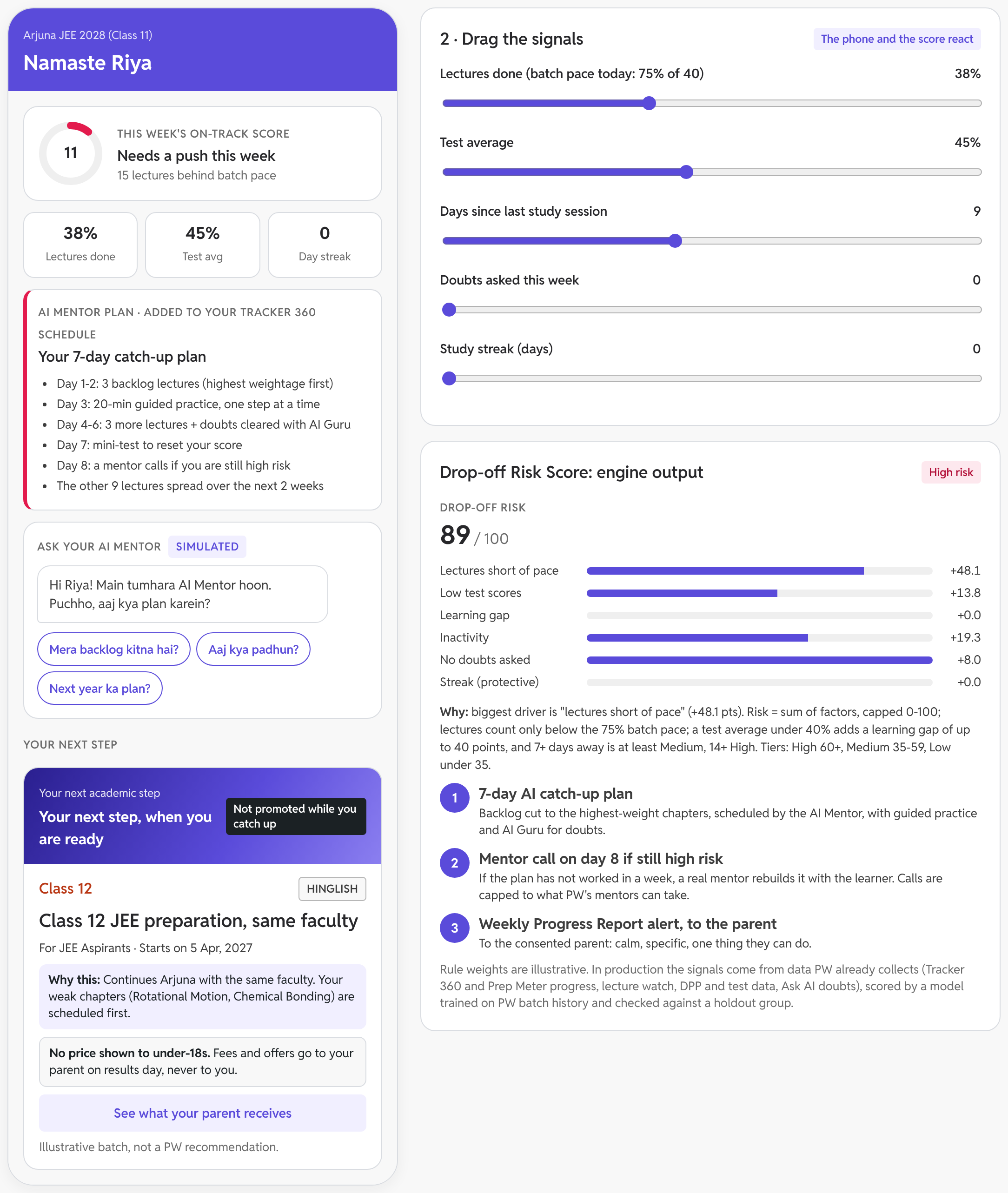
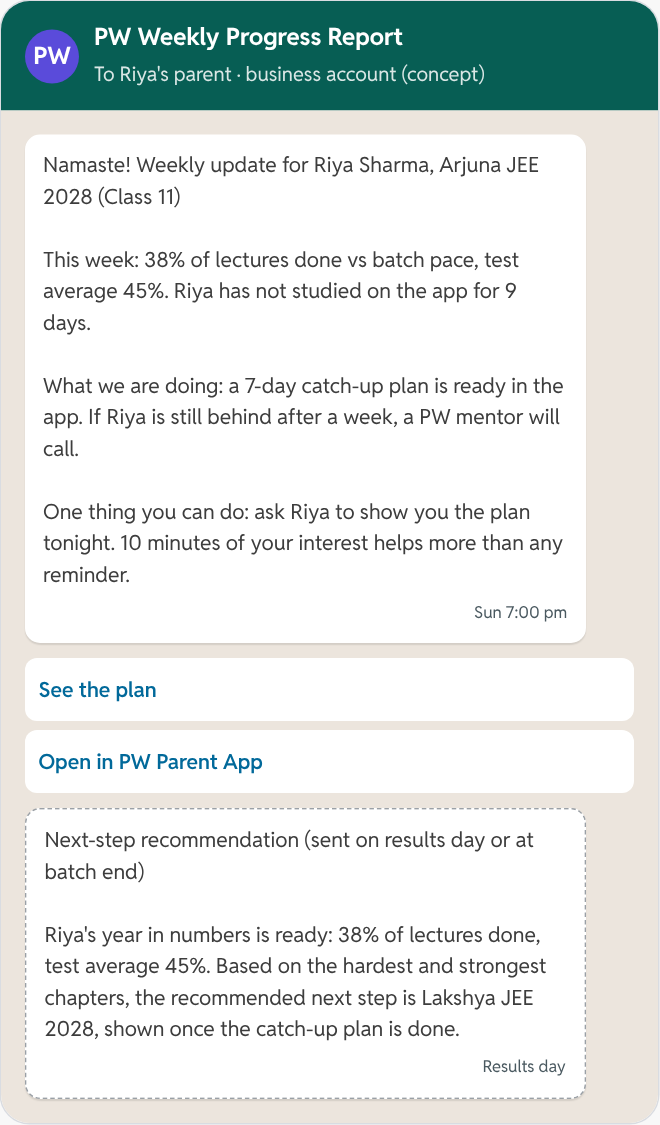
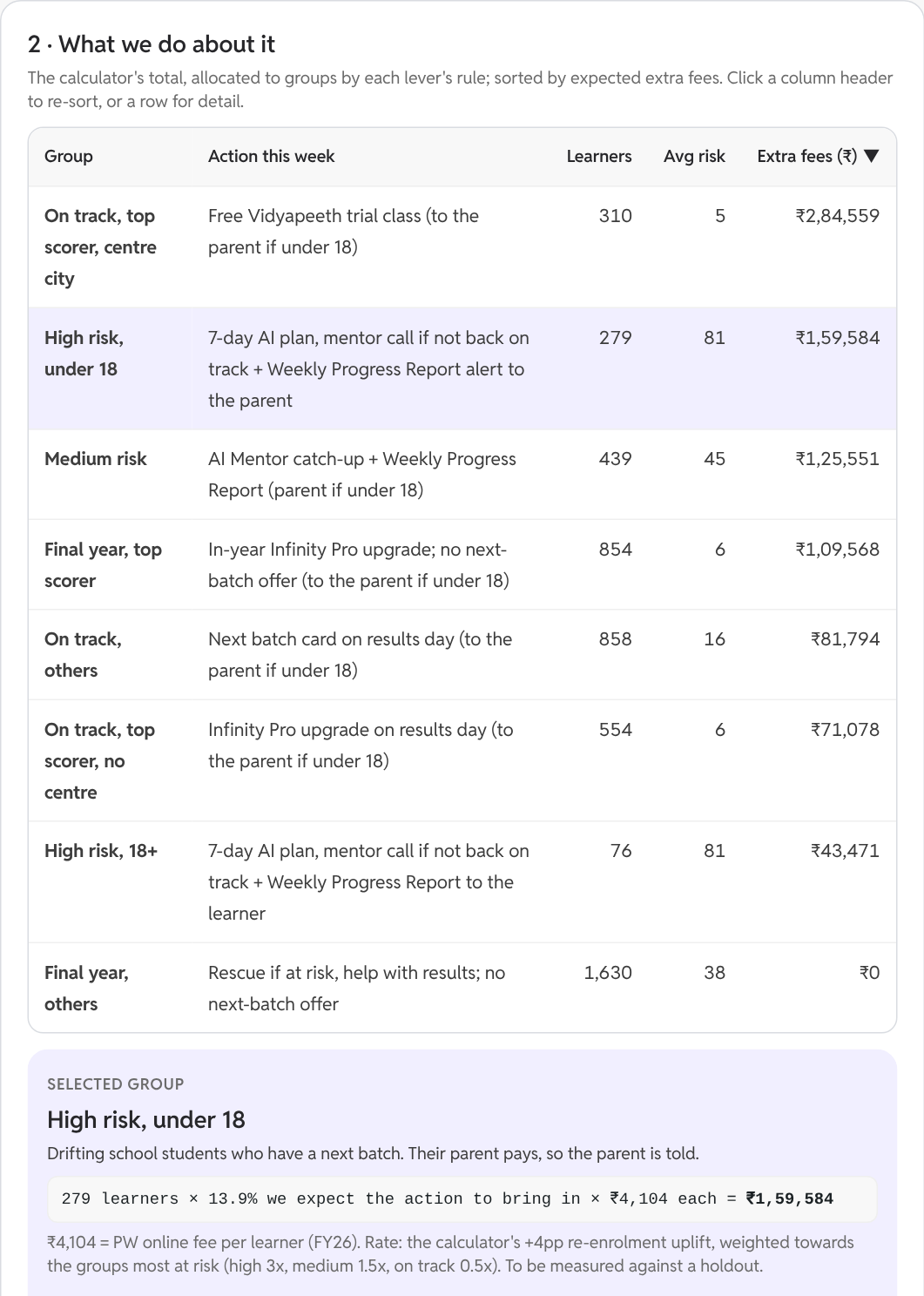
Screenshot of concept student experience with on-track score and catch-up plan01 · Learner app Screenshot of proposed weekly progress report message02 · Progress report Screenshot of synthetic renewals dashboard03 · Dashboard Real demo screenshots · Fictional learners

Screens use fictional learners and illustrative rules-not a trained or deployed AI system. Research evidence · AI design · Interview walkthrough.

01 Overall goal

Identify PW's highest-leverage AI-led growth opportunities, starting with learner needs

I set out to understand PhysicsWallah's business, the learner journey, existing AI capabilities and public customer feedback; rank problems worth solving; and demonstrate how a product leader could move from evidence to a viable growth experiment.

Central question

How can PW improve learning continuity-and earn greater next-stage enrolment through better outcomes?

I selected one testable hypothesis: when a paid learner misses practice, could a manageable catch-up intervention using existing PW tools help them recover? This is an opportunity to investigate, not proof that PW has an internal retention problem.

See why it ranked first →

RESEARCHUnderstand the opportunity

Business economics, user feedback and existing experiences.

STRATEGYChoose the right problem

Prioritise user need, evidence, impact, risk and feasibility.

EXECUTIONDemonstrate the solution

Clickable prototype, rollout plan and measurable outcomes.

Completed independently: public audit, synthesis, opportunity ranking, interactive prototype and scenario model. Not yet done: internal PW research, real-user experiments, trained model or actual revenue lift.

02 What I examined

PW’s business, learner journeys, AI stack and public feedback

Initial product-page audit completed 25 Oct 2026, logged out; official filing review updated through 4 Nov 2026: 45+ pw.live pages (home, batch listings, batch detail pages across JEE, NEET, UPSC and Class 10, Vidyapeeth, Test Series, Power Batch, Prerna, Tracker 360) and 9 PW apps on Google Play and the App Store, plus PW's own filings. Nothing was purchased and no forms were submitted.

45+Public PW pages
9App listings
1,425Public reviews
FY26-27Financial and AI disclosures
Business model

Online/offline monetisation, course categories, centres and seasonality.

Learning products

Batch discovery, Tracker 360, Prep Meter, guided practice and parent app.

Customer evidence

App feedback, education studies, public AI-product adoption and retention disclosures.

All review counts are from the documented sample, not representative user-survey results; no internal PW data was available.

Observed

Existing PW learning AI

AI Guru, guided practice, Pi Lens, Tracker 360 and Prep Meter already support parts of this journey.

Opportunity to test

A smaller recovery moment

Could a missed-practice trigger guide a learner back to one useful task without introducing another planner?

Strategic implication

Link learning to continuation

Evaluate one targeted academic recovery intervention first, and measure next-stage enrolment only after cohort maturity.

Inspect the complete capability-by-capability audit and filters
CapabilityStatusWhat I saw (verbatim where quoted)Where
AI doubt solvingLive"24*7 Doubt Resolution powered by Ask AI Feature"; Ask AI 3.05M+ doubts at 91% satisfaction; AI Guru 99.45M+ queries (Q4 FY26), 108.8M from 6.09M students (Q2 FY27).Batch pages; Q4 FY26 and Q2 FY27 letters
AI counselling and lead AILiveVoice bots handle 6,000+ calls a day at ~75% lower cost; smart lead routing gives "~10% higher revenue per lead"; a lead model processed 2+ crore leads.Q4 FY26 letter
Study planner with on-track statusLiveTracker 360, "a PW study planner": shows tasks done against the plan, an end date and how many days the learner is "behind schedule"; streaks; "Miss a day and the plan rebalances around what is left".tracker360.pw.live; included in plans such as NEET 360
Chapter preparation trackerLivePrep Meter (Backlog Killer): "Track your chapter-wise preparation level and get personalized roadmap".Infinity plan inclusions
Parent visibilityLivePW Parent App: "View their attendance, lecture, DPP, and test stats on the student dashboard"; 10L+ downloads, 4.0 rating; parent login at spd.pw.live.Google Play com.pw.parent; App Store
Human mentorshipLiveInfinity Pro "1:1 Mentorship": "Two 30-minute monthly sessions with PW alumni for career and strategy guidance"; Infinity "Topper Mentorship Program"; Prerna wellbeing teleconsultation.Batch pages; Prerna page
AI MentorLive0.52M+ users served (also available to non-PW students). Not visible on public web pages.Q4 FY26 letter
Continuation into next yearPartialCombo batches (e.g. Arjuna NEET 2026 + Lakshya NEET 2027); "Free Upcoming Versions"; Vishwas Diwas early buyers "automatically upgraded". CuriousJr only: "preview next year's course offerings and unlock early-enrollment benefits".Batch pages; PW news; CuriousJr Play listing
Online to offlinePartialOnline batches mention "Exam guidance at our PW Offline centers"; Vidyapeeth counselling bookable through the app. No Vidyapeeth trial or demo class found.Batch pages; Vidyapeeth Utsav page
Weekly progress report to the learnerNot foundOnly test-performance reports and dashboards; no weekly summary pushed to the learner.Searched site, store listings, filings
WhatsApp updates to parentsNot foundParent data lives in the app; a parent has to open it. No push digest found.Searched site, store listings
Personalised next-batch recommendation on results day (main app)Not foundNext-year preview exists in CuriousJr only.Searched site, store listings, filings
Renewal offer for existing online studentsNot foundNo renewal or loyalty price for existing online learners on batch pages, offer pages or store listings; the offers found were for new bookings, such as Vidyapeeth Utsav 2026 scholarships.Batch and offer pages; Vidyapeeth Utsav page
One layer connecting risk signals to actionsNot foundEach tool sits in its own plan or app; no public evidence of a cross-plan risk signal that triggers mentor, parent or next-step actions.Internal systems not visible publicly

Sorted Live → Partial → Not found. "Not found" means not publicly documented; logged-in experiences, push notifications and internal tools could differ.

Acquisition audit · SEO + AEO

How learners discover the right PW course through Search and AI answers

I reviewed a small public sample of PW batch landing pages, the published crawler rules, and Google Search Central's AI search guidance. This is an opportunity audit, not an assertion about PW's rankings, technical defects or conversions.

Observed · Content

Current-year intent is sometimes diluted

The 2027-focused NEET Class 12 and JEE batches pages include 2026 exam/counselling context near the opening.

Improve: lead with the target-year decision, clarify current batch eligibility and update dates, then separate archived exam-cycle news.

Observed · Discovery foundation

Course information and crawl controls exist

PW publishes course tables, target years, schedules and FAQs; its robots.txt links to a sitemap and restricts study/practice paths, which may intentionally protect app experiences.

Improve: audit indexable public landing pages, internal links and canonical/structured-data alignment. Do not remove restrictions without knowing their purpose.

Proposed · SEO

Make the next action obvious by search intent

  • Group pages by target exam year, class, language and online/offline mode.
  • Put reviewed batch comparisons and current entry dates above unrelated updates.
  • Link to the right cohort and explain what's included before login or payment.
Proposed · AEO / AI discovery

Publish precise, source-backed answers

  • Use visible, verified Q&A for real questions: suitability, duration, language, fee and support.
  • Align structured data with visible, current content; cite official exam sources.
  • Keep pages crawlable and useful; Google does not require AEO-only schema or llms.txt.
P0 · Validate

Sample GSC landing pages, queries, impressions, CTR, indexation and qualified enrolment starts.

P1 · Test

Update a matched set of 2027 batch landing pages and compare with unaffected pages.

P2 · Measure

Track non-branded discovery, course-match clicks, enrolment conversion and sourced AI citations where observable.

Limits: I did not have access to PW Search Console, analytics, crawl logs, site-wide schema diagnostics, AI referral reports or paid enrolment attribution. Google doesn't guarantee indexing or inclusion in AI answers. Any ranking or revenue impact remains unmeasured.

03 Evidence-backed findings

Six public observations, each connected to a product decision

These findings come from sampled PW pages, app reviews and published company reports. A review is a customer signal, not evidence of how often a problem occurs. I separate what I observed from what I would test.

Finding 1 · Existing AI products

PW already has a learning-AI foundation

AI Guru, guided practice, Pi Lens, planning and mentorship are publicly described PW capabilities. PW reports higher week-three retention alongside Pi Lens daily challenges (30%+ improvement); this does not prove that a new recovery intervention will work.

Product implication: connect existing tools around a specific missed-practice moment; avoid another generic AI tutor.

Finding 2 · Parent experience

Some parents report missing or inaccurate progress data

Selected Parent App reviews mention attendance, lesson activity and assessment records that do not appear as expected.

Product implication: validate event reliability before launching automated progress reports. See sample reviews.

Finding 3 · Batch expiry

Course transitions can create navigation friction

Sampled learner reviews describe expired-batch access concerns and ask for clearer batch navigation.

Product implication: clarify expiry, remaining access and the educational next step. See the evidence.

Finding 4 · Category mix

Growth is broader than JEE and NEET

Categories beyond JEE-NEET contributed 73.8% of H1 FY27 enrolments, up from 64.8% a year earlier, according to PW's 4 November 2026 shareholder letter.

Product implication: do not apply a single renewal or growth playbook to Foundation, Board/CUET, JEE/NEET and professional exams. Prioritise and measure by category and learner stage.

Finding 5 · Mentorship expectations

Some paid learners question what support is included

A sampled app review says 1:1 mentorship was expected but an additional paid offer appeared after enrolment. One review is not proof of a systemic fulfilment problem.

Product implication: audit plan-level entitlements, show mentor access and response expectations clearly, and test support handoffs before promising new interventions. See review.

Finding 6 · Search discovery

Some exam-year pages mix current course intent with past-cycle updates

PW's Class 12 NEET batches page lists 2027 preparation but opens with August 2026 counselling; the JEE batches page similarly mixes 2027-28 intent and 2026 exam context.

Product implication: align titles, opening answers, course comparisons and update dates to the learner's target exam year. See the SEO/AEO review.

In learners' and parents' own words

I read 1,425 public reviews of the PW app and the PW Parent App, collected 26 Oct 2026. Quoted verbatim; names left out.

How the reviews were read

680 and 677 on Google Play, 68 on the App Store; the PW app ones are from 2026, the Parent App ones from Feb 2024 on. About half the PW app reviews are 5★ praise for the teaching; of the 270 rated 1-3★, 214 are about bugs or support. In the Parent App, 105 of 677 Google Play reviews (15.5%) mention reports, progress, attendance or results, and 61 of those (58%) rate it 1-3★, mostly because the data is missing, wrong or too thin; most of those are from 2024. No interviews yet: ten learner and ten parent calls are in the first three weeks of the plan.

"It should have overall insights as well, like monthly and overall, and also option to check previous weeks or custom range data."
Parent App, App Store · 1★ · 3 Aug 2026
"the test records and my ward’s attendance are not showing on the portal yet."
Parent App, Google Play · 1★ · 17 Sep 2026
"my child is improving day by day. But your guidance and counseling can play a significant role to make the future of young ones."
Parent App, Google Play · 5★ · 16 Jul 2026
"I paid a hefty amount for the Shreshth 2.0 Infinity batch, yet it expired and I lost access to the content I purchased."
PW app, Google Play · 1★ · 9 Jul 2026
"Please add an option to hide expired batches from seeing while navigating through the 'my batches' section."
PW app, Google Play · 4★ · 22 Jul 2026
"there is mentioned that 1 to 1 mentorship but when we purchase the batch,then there is only paid no mentorship."
PW app, Google Play · 2★ · 5 Aug 2026

My interpretation, not a population estimate: some reviewers want clearer progress summaries, some describe confusion around batch expiry, and some question mentorship delivery. Self-selected reviews do not establish prevalence or causality. I would validate each with enrolled learners, parents and support tickets before prioritising a fix.

See evidence → potential product action → validation requirement
Observed public signalPossible improvementWhat I would verify internally
Existing AI-guided practice and learner-planning toolsIntegrate one targeted catch-up task into the current learning flowCurrent recovery interventions, adoption, learning uplift
Sample Parent App complaints about reporting reliabilityReconcile progress and attendance events; show freshness and confidenceEvent completeness, actual incident rate, parent consent
Public batch-expiry and navigation complaintsMake expiry and academically relevant next steps explicitSupport ticket incidence, access policy, eligible transition paths
Non-JEE/NEET categories now represent 73.8% of H1 enrolmentsSegment growth experiments by academic stage and categoryCohort size, retention/activation, gross margin by segment
Sample mentorship entitlement complaintShow verified inclusions and service expectations at purchase and in-appEntitlement definitions, capacity, response times, complaint incidence
Mixed exam-year context on selected public batch pagesRefresh current-intent answers and course selection pathwaysGSC queries/CTR, crawl diagnostics, conversion tracking, AI citations
04 What matters most · Priority ranking

Seven growth opportunities ranked by learner value, evidence and speed to proof

My proposed priority order weighs learner need, available evidence, likely impact, ease of experimentation, new dependencies and risk. These are qualitative judgments-not calculated company RICE scores. Internal PW metrics could change the ranking.

1

Guided catch-up after missed practice

Clear learner moment, existing learning assets, low-friction A/B test and early academic outcome.

Dependency: validate missed-work events, cohort eligibility and current support.
P0 · First pilot
2

Progress data quality and trustworthy updates

Some Parent App reviews surface reporting friction; reliable records are essential before sending summaries.

Dependency: data reconciliation, consent and age-appropriate legal design.
P0 · Foundation
3

Results-day pathway to the appropriate next batch

Potential continuation lever aligned to natural course transitions, after learning value is established.

Dependency: eligible repeat enrolment baseline, timing and commercial holdout.
P1 · Growth test
4

Online-to-Vidyapeeth class trial

Could put suitable online learners in existing-centre seats, but execution depends on local capacity and counselling.

Dependency: academic fit, seat utilisation, geography and incrementality.
P1 · Local pilot
5

SEO + AI-answer discovery for the right batch

Selected JEE/NEET landing pages mix target-year course choices with prior-cycle updates. Test refreshed, answer-first comparisons and clear academic-stage routing.

Dependency: public SEO/AEO review, Search Console, search-intent cohorts and paid-enrolment attribution.
P2 · Organic growth
6

AI tutor premium packaging

Potential monetisation, though PW already reports AI Tuto development-avoid duplicating its roadmap.

Dependency: usage, price elasticity and educational quality.
P2 · Align first
7

Study-gap books and test-series bundles

Cross-sell has less direct evidence of an underserved learning need than recovery and progress transparency.

Dependency: purchase intent, contextual relevance and incremental value.
P3 · Later

Prioritisation decision: prototype #1, make #2 a prerequisite to trusted messaging, and keep #3-4 as downstream growth bets. If internal data favours activation or new-payer conversion instead, change the order.

05 Changes I suggest · And why

Start with one learner recovery MVP; evolve only after evidence

The problem to validate. When a paid learner falls behind, knowing the backlog is only useful if they have a manageable way to resume. PW already has Tracker 360, guided practice and daily challenges. The first test uses those tools to see whether a specific catch-up task gets the learner studying again. As a sensitivity check, a scenario with 50% next-batch eligibility and 40% repeat enrolment implies about ₹600 cr a year in illustrative fees associated with eligible non-returners. A +4-point lift would capture about 7% of that scenario. Actual eligibility, prices and repeat enrolment need validation.

Study signalMissed meaningful practice
ValidateCheck event quality & eligibility
GuideOne syllabus-aligned task
LearnRecover practice & mastery
MeasureIncremental effect vs. control
First · MVP

One catch-up action

Use an existing practice set and a small in-app trigger. Why: smallest testable change with direct academic benefit; no model or new content required.

Next · If effective

Support and progress clarity

Validate source data, add mentor help where useful, and consider factual summaries where permitted. Why: accuracy, trust and human escalation matter.

Later · Commercial

Next stage and centre trial

Offer relevant progression to eligible audiences with a separate holdout. Why: prove incremental enrolment rather than assuming revenue follows engagement.

The following five features are a proposed mature system, not five features to launch together. The detailed AI architecture remains in the appendix.

Feature 1Drop-off Risk Score

A proposed 0-100 drop-off score for legally eligible learners, using validated progress and practice signals. Start with interpretable rules; use trained prediction only if it outperforms that baseline, is calibrated and clears privacy review.

For: the team that owns renewalsSee the risk score
Feature 2Catch-up Plan

Made by the AI Mentor from PW's own AI: guided practice, AI Guru for doubts and Daily Challenges. A human mentor calls on day 8 only if the learner is still high risk. An hour of AI Tuto is tested as a pilot arm.

For: the learnerSee Riya's plan
Feature 3Weekly Progress Report

A factual, opt-in weekly summary from verified progress events, sent to consenting adults. Any report involving a child needs specific parental consent, purpose limitation and legal approval; it is not a sales channel.

For: the parent or the learnerOpen the weekly report
Feature 4Next-Step Recommendation

A next-stage learning pathway after the learner has recovered, with batch or centre options where appropriate. Commercial recommendations are evaluated separately from child behavioural monitoring and require legal approval.

For: the learner and parentSee the recommendation
Feature 5Renewals Dashboard

The Monday screen for the team that owns renewals: learners grouped by action, what each group is expected to win back, and the running cost.

For: the team that owns renewalsOpen the dashboard

First decision: does a catch-up plan get more paid learners back to meaningful practice than the current experience? Read the experiment · Inspect the expansion economics

06 Prototypes with working demos

See what I built-open each view and test its interactions

Each preview is a screenshot from the actual interactive prototype I built. Open a screen to inspect its corresponding demo view. All learners, scores and financial results are fictional.

STEP 1Choose Riya or Kabir in the student view.
STEP 2Change practice, test and inactivity signals.
STEP 3See the illustrative plan and progress report.
STEP 4Challenge economics in the dashboard.
07 GTM strategy and expected output

Launch as a learning experiment, then scale only if it earns the right

This GTM plan is proposed, not executed. The first audience is a legally eligible group of paid learners who missed planned practice. Distribution starts inside the existing PW study journey, not through a blanket marketing campaign or new discount.

Phase 0 · Discovery

Validate and instrument

  • Interview learners, mentors, product owners and data teams.
  • Confirm current rescue flows and reliable practice-event definitions.
  • Choose a legal/consented adult cohort unless child-data use is approved.
  • Pre-register treatment, holdout, learning guardrails and economic thresholds.
Phase 1 · In-app pilot

Deliver the first win

  • Trigger: learner misses a verified scheduled practice set.
  • Channel: existing PW app / Tracker 360 and guided practice.
  • Offer: one syllabus-aligned catch-up task; no sales nudge.
  • Experiment: 50/50 existing experience vs. catch-up intervention.
Phase 2 · Conditional scale

Expand on demonstrated value

  • Review 7-day meaningful recovery, 8-14 day continued practice and independent mastery.
  • Add opted-in, lawful progress summaries and mentor support only if beneficial.
  • Test eligible course continuation and centre referrals separately.
  • Roll out by cohort with monitoring and a persistent control group.
Primary outcome

Learning recovery

Incremental 7-day completed meaningful practice vs. randomised control, with repeat practice in days 8-14.

Guardrails

Quality and learner trust

Unassisted mastery, complaints, errors, opt-outs, fairness and cost per extra recovered learner.

Later business outcome

Next-stage enrolment

Incremental paid enrolment and contribution after the eligible buying window, net of refunds and costs.

Illustrative revenue sensitivity · 10,000 eligible learners

At an illustrative ₹4,104 per additional enrolment. These are assumptions, not a measured or predicted uplift.

Next-stage liftExtra enrolmentsGross collections
0 pp0₹0
+2 pp200₹8.2 lakh
+4 pp (scenario)400₹16.4 lakh
+6 pp600₹24.6 lakh

Not profit, EBITDA or a forecast; excludes refunds, substitution, incremental service delivery and programme expenses. The full sensitivity model is in the appendix.

Scale / stop decision

  • Scale: reliable data, meaningful incremental recovery, sustained practice and no mastery harm.
  • Economics: incremental intervention value exceeds delivery and support costs.
  • Wait: next-stage conversion cannot be claimed before cohort maturity.
  • Stop: no educational benefit, privacy issues, disproportionate harms or unviable unit economics.

Experiment design · Rollout gates · Business model

Parallel acquisition workstream · Organic search

SEO + AI-answer pilot: match learner intent to the right batch

Start with the sampled 2027 JEE/NEET pages, confirm their non-branded query demand in Search Console, improve exam-year clarity, course comparison and dated source answers, then measure matched-page performance. Keep this separate from the in-app recovery experiment to avoid attributing organic acquisition to retention nudges.

Audience

Organic visitors comparing target year, class, language and batch format.

Channel

Existing search-indexable PW landing pages and helpful source-grounded answers.

Expected outputs

Validated query clusters, updated landing-page template and measured qualified enrolment starts; no guaranteed ranking or AI citations.

Decision: scale by cohort only if the test shows incremental qualified discovery/conversion with no informational or compliance harm.

GTM sequence: learning rescue → repeat practice and mastery → trusted, consented support → relevant next course → measured incremental contribution. A large modelled opportunity does not justify scaling an unsuccessful pilot.

Current PhysicsWallah initiatives

What PW is already shipping, piloting and expanding

Officially reported initiatives, as of the 4 November 2026 shareholder letter. Kept separate from my recommendations so interviewers can immediately see what I propose to reuse rather than duplicate.

Current initiatives · 4 November 2026

What PhysicsWallah is already building and scaling

I reviewed PW's official Q2 FY27 shareholder letter. The labels below distinguish products already live, limited pilots, and stated expansion plans; the numbers are company-reported, not my independently measured product metrics.

Live · Scale

AI Guru + guided practice

108.8M queries across 6.09M students. Guided step-by-step solving was newly added to practice sets in Q2 FY27.

Build on: existing question content and pedagogy for a recovery MVP.

Live · Scale

Pi Lens + PW Pi

Pi Lens added 1v1 Battles, Concept Labs and Daily Challenges; PW reports 54K+ paid PW Pi subscribers.

Build on: low-friction practice habit loops, not an additional generic tutor.

Pilot · Expanding

AI Tuto, conversational tutor

Class 8 pilot with ~1,500 voluntary learners; PW reports a 4.8/5 user rating and ~₹17/hour voice-tutoring cost. Extension to other grades is planned.

Build on: supervised, syllabus-grounded recovery support; do not duplicate Tuto.

Live · Monetising

PW Books + premium learning

PW reports 49K paying learners for AI-first PW Books and Infinity/Pro collection growth of 32% in H1.

Build on: proof of willingness to pay, with learning value and tier entitlements made clear.

Scaling · Growth

Foundation, Boards/CUET, Curious Junior

Non-JEE/NEET categories reached 73.8% of H1 online enrolments; Boards/CUET enrolments rose 130%. Curious Junior collections more than doubled.

Build on: stage-appropriate academic journeys; do not use one JEE/NEET playbook for every learner.

Scaling · Regional

Vernacular + South India

1.23 lakh vernacular enrolments across 10 languages (+77% YoY). South India is an online-first growth focus, with 63 centres reported.

Build on: language and region-specific course discovery, onboarding and support.

Announced · Next cycles

NEET recovery + crash courses

PW disclosed NEET enrolment timing effects and outlined short-duration crash-course expansion through Q3/Q4.

Build on: exam-calendar-aware acquisition and continuation journeys.

Live · Operations

AI support + capital discipline

PW reports AI resolves 80% of student-support queries; offline expansion has shifted toward improving existing-centre utilisation.

Build on: reliable escalation and seat-aware centre referrals, not new unvalidated call workloads.

In development

Tuto study lamp

PW outlines an early-stage camera-enabled tutoring lamp with on-device processing, a physical shutter and parental controls.

Build on: privacy-by-design patterns; treat this as R&D, not an already-shipped consumer product.

Strategic takeaway: PW has already invested in tutoring AI, practice, premium products, K-12 expansion and regional discovery. My proposal is not another AI feature; it tests incremental learning recovery at a specific moment and complementary search-to-course journeys on top of that stack.

For source-level capability details, see the Research Audit. For my proposed changes, see Proposed Changes. Company-reported adoption figures are not independently measured learning outcomes.

Supporting evidence and technical appendix

AI architecture, complete feature specification, experiments, rollout gates, risks, full financial scenarios, the original business analysis and a shareable walkthrough.

04 · Why this product, and why PW AI

The Learner Retention Engine: one layer on top of what PW already runs

No new learning content, faculty or capex. It connects the signals PW already collects to actions PW already knows how to take, for every learner on every plan: spot, rescue, inform, renew, run. The five features are described at the top of the page; this section is what they reuse, what they add and the evidence behind them.

Built on PW's own AI, not next to it

PW-reported results from the Q2 FY27 shareholders’ letter, section F and the 4 November earnings call, page 11.

PW productWhat PW reportsIts job in the engine
AI Guru108.8M queries from 6.09M students, cumulative through 30 September 2026Answers doubts inside the Catch-up Plan; doubts asked is one of the risk signals
Guided AI tutor in practice sets20%+ adoption and 70% session completion in the first guided-practice release in PW BooksThe practice steps of the Catch-up Plan: work through a question, not read an answer
PW Pi and Pi LensPi Lens daily challenges reached 60% adoption, with 30%+ higher week-three retention reported alongside the feature. PW Pi had 54,000+ paid subscribers. The comparison design is undisclosed.The medium-risk nudge: a daily challenge on the weak chapter before any message is sent
AI TutoManagement reported delivery cost below ₹20 per tutoring hour and said it was still exploring pricingA pilot arm, not in the base cost: one hour of one-to-one AI teaching in the high-risk 7-day plan, before any human call
AI support80% of support queries resolved without a person; satisfaction up from 2.8 to 3.7The same AI-first, person-on-exception pattern, applied to renewals
What it reuses from PW, and what it adds

Reuses (already live)

  • Tracker 360 and Prep Meter progress signals
  • AI Guru, guided practice, AI Mentor and 1:1 mentors as the rescue channels; AI Tuto as a pilot arm
  • PW Parent App as the place a parent lands
  • Infinity and Infinity Pro plans; 370 centres (Q2 FY27)
  • Lead AI and voice bots for follow-up calls

Adds (not found today)

  • One cross-plan drop-off risk score with reasons
  • Risk- and age-based routing of actions
  • Weekly Progress Report pushed on WhatsApp
  • A personal next-step recommendation in the main app
  • Online-to-Vidyapeeth trial class for strong learners in centre cities
  • Study-circle check-ins: an opt-in peer group for adult learners
  • A holdout to prove incremental lift
Design proposal · not built or trained

What actually needs engineering-and what does not need a new LLM

Separate deterministic student records, predictive ML, content-grounded generation and causal measurement. The clickable demo uses hand-written rules only.

1 · Data quality

Trusted learner events

Reconcile attendance, DPP, tests and Tracker 360 events with server logs; handle delayed sync, offline study and exam breaks. Unknown means unknown-not “high risk.”

2 · Decision policy

Start deterministic

A transparent missed-practice rule can launch the first A/B test. Route only eligible users; child data requires a separate legal basis and approved purpose.

3 · Predictive ML

Add only if valuable

Compare calibrated logistic / tree baselines with simple rules using temporal holdouts, top-k precision, cohort calibration and false-positive rates by segment.

4 · AI intervention

Use PW’s learning stack

Retrieve only authorised batch content; generate a short plan using approved learning assets. Validate syllabus coverage, factual accuracy, safe tone and cost; fall back to reviewed templates.

5 · Experimentation

Prove incremental benefit

Randomise at learner or household level; estimate practice recovery and mastery against existing support. Test intervention uplift and cost per incremental recovery-not AUC alone.

6 · Safe scaling

Observe and abstain

Instrument opt-outs, learning harm, hallucinations, delivery failure and subgroup drift. Pause unsafe flows; keep education separate from behavioural commercial targeting.

Key AI product judgment: a model that predicts dropping out does not prove that any particular message will prevent it. The product earns its place only when the intervention improves learning, fairly and economically.

What the research says, and what it changed in the design

Show the nine studies

Field experiments, a review and a meta-analysis, checked 14 Nov 2026. Most come from the US and Botswana: I found no Indian trial of WhatsApp progress reports, which is exactly what the pilot is for.

FindingSourceWhat it changed here
Weekly automated texts to parents about missed work, grades and absences cut course failures by 27% and raised attendance by 12%; fewer than 2% of parents opted outBergman and Chan, Journal of Human Resources, 2021The Weekly Progress Report is weekly, automated and factual
Weekly teacher-to-parent messages cut failure to earn course credit from 15.8% to 9.3%, a 41% reduction, mostly by preventing dropouts; messages about what to improve worked bestKraft and Rogers, Economics of Education Review, 2015Every report ends with one thing the parent can do
Text messages plus phone calls raised learning by 0.121 standard deviations; text messages alone had no effectAngrist, Bergman and Matsheng, Nature Human Behaviour, 2022High risk escalates to a human mentor call on day 8: a message alone is not the rescue
Five texts a week instead of three raised parent opt-outs by 2.9 points, 58% over a 5% base, and worked no betterCortes, Fricke, Loeb and Song, Education Finance and Policy, 2021One report a week, and at most one alert in between
A dropout model trained on one week of activity reached an AUC of about 0.8 on a later run of the course; testing on the same course overstates accuracyGardner and Brooks, User Modeling and User-Adapted Interaction, 2018The go/no-go backtest asks for 0.70, tested on a later cohort than it was built on
Across 11 studies, dropout models catch most dropouts (sensitivity 0.94) but raise many false alarms (specificity 0.77)Tenorio-Berrio, Pérez-Martín and Letón, Tsinghua Science and Technology, 2026The first action is a cheap AI plan; a person calls only if a week of it fails
Re-enrolment reminders alone are often too weak: no effect across 800,000 students; texts alone had a small, insignificant effect that rose to 1.5 points (21%) with a one-course fee waiver; aid-renewal texts kept 14 points more community-college students enrolledBird et al., 2021; Ortagus, Tanner and McFarlin, 2020; Castleman and Page, 2016The Next-Step Recommendation names a specific batch and the reason, not a generic reminder, and every lever keeps a holdout
05 · What I actually built

A working interactive concept-not a deployed AI product

The screenshot gallery appears near the top of this study so a hiring manager can inspect it before reading the appendices. Four fictional learner profiles, adjustable inputs, report previews and an editable cohort calculator work in-browser; no PW APIs, real learners, trained ML or measured growth are involved.

Or expand the interactive prototype within this page (desktop)
06 · The first experiment I would run

Before prediction or renewals: test whether a catch-up plan helps learning

Start with one paid online Class 11 JEE batch, subject to age and consent review. Check how the existing experience handles overdue practice before choosing the intervention. If permissions are unavailable, start in an eligible 18+ batch.

Trigger

A learner misses a planned practice set and completes no other set for seven days. Validate the underlying events and suppress the trigger during planned breaks.

Intervention

Randomise 50/50 at the first trigger. Both arms keep existing support and the same messaging cadence. The treatment sees a short in-app plan with a guided question and a link to approved batch material.

Decision

Read the share of assigned learners who complete a syllabus-aligned practice set in seven days. Check repeat practice in days 8-14, unassisted mastery on matched questions, complaints, subgroup effects and cost per incremental meaningful recovery. Read eligible next-cycle enrolment only when that window matures.

At a 40% baseline and a 4 percentage-point minimum detectable lift, a two-sided 5% test with 80% power needs about 4,800 learners across two equal arms. Recalculate on actual cohort volume and account for any household clustering.

See the catch-up prototype · Review the wider rollout design

07 · Conditional rollout

Validate data and learning lift before adding AI complexity

If the first experiment shows durable practice recovery, this design tests the wider programme in grades with a next batch.

Weeks 1-3 · Baseline and go/no-go
  • Week 0: PW legal reviews permissible child-data purposes, verifiable parental consent and marketing separation; without approval, pilot only an 18+ cohort
  • Pull two past cohorts; define drop-off and renewal per category
  • Compare simple rules to a temporally held-out calibrated predictor; evaluate ROC-AUC, precision at mentor capacity, calibration and subgroup errors. Only add ML if it beats simpler rules
  • Ten learner and ten parent interviews
Weeks 4-8 · Pilot the rescue
  • Eligible adult cohort first unless a legally approved education-only design permits Class 10 / 11 involvement
  • 90/10 holdout, randomised by household so siblings share an arm: about 14,500 learners give 80% power that the lift's lower 90% bound clears the 0.62pp break-even if the true lift is +4pp on a 40% base
  • One treatment arm decides scale; if it passes, phase 2 splits report, plan and offer in a factorial to read each part
  • Weekly Progress Report for opted-in parents and learners; read 7-day reactivation weekly
  • AI Tuto arm: half the high-risk group also gets one AI Tuto hour; it scales only if recovery rises 11.3 points, its cost break-even, or renewal rises enough to cover the gap
Weeks 9-13 · Next-step recommendation
  • Results-day recommendations go live for the March batch end; the renewal read follows in April
  • Vidyapeeth trial in 5 centre cities, using empty seats in classes already running, so each trial costs little beyond the counsellor's follow-up, offered to parents of under-18s
  • Read-out of leading signals; the scale decision waits for the renewal read
North star

First experiment: incremental meaningful practice recovery with verified mastery. Later business outcome: eligible next-cycle enrolment versus holdout, assessed after the next-batch buying window.

Leading

Meaningful practice completion, day 8-14 repeat practice, unassisted topic mastery; later upgrade and trial-to-seat rates.

Guardrails

Learning harm or pressure, opt-outs, refunds, complaints, error rates and unequal false positives. Final-year learners can get educational help without a next-batch sales offer.

What has to be true to scale

WhenPassIf it fails
Week 3Temporal backtest beats a rules-only baseline; adequate calibration, top-k precision for mentor capacity and subgroup error rates, with an approved lawful data basisShip the results-day tool only
Week 8Material increase in meaningful seven-day practice recovery against randomised control, sustained day 8-14 practice, no deterioration in unassisted mastery, and acceptable opt-out / complaint / cost thresholdsChange the plan or the message, rerun for 4 weeks
Next batch startThe lower 90% confidence bound on next-cycle enrolment lift sits above 0.62pp, the break-evenPoint estimate above 0.62pp but the bound below it: widen to more grades: showing that a 2pp lift clears the 0.62pp break-even needs about 87,000 learners, six times the pilot. Point estimate below 0.62pp: stop, keep the results-day tool

Renewal can only be read when a batch ends. For a pilot starting in December 2026, Class 10 and 11 batches end around March 2027, so the first renewal read is around April 2027; weeks 4-8 read leading signals in the meantime.

Keeping the AI honest

  • Numbers are never generated: every figure in a report is filled from Tracker 360 and test data, and the wording comes from a library of reviewed templates per risk tier and language, so the 127M weekly reports carry no per-message AI cost. A report whose numbers fail a check against the source is not sent. The AI writes only the AI Mentor plans, which are costed.
  • Plans stay inside the syllabus: the AI Mentor builds plans only from the learner's own batch lectures, DPPs and practice sets; plan acceptance (the learner starts day 1) is tracked weekly.
  • People read a sample: 200 reports a week in each language are reviewed by a native speaker for accuracy and tone; any error pauses that template.
  • Learning, not just renewal: the first pilot is judged on meaningful completed practice and sustained study, with unassisted concept mastery as a critical guardrail. Increased sales cannot compensate for worse learning.
08 · Risks and stop conditions

Riskiest assumptions, and the cheapest test for each

AssumptionWhy it could be wrongCheapest test
Drop-off is predictable earlyLearners may drop off suddenly, close to examsBacktest last year's data before building anything
The signals are accurateParent App reviews report watch time and DPPs not updating: "It shows, 6 minutes of lectures progress when actually I did 2+ hours" (Google Play, 23 Sep 2024)Reconcile one week of Tracker 360 and Parent App data with server logs; send no report on a signal that fails
People act on nudgesWhatsApp fatigue; reports get ignored2-week report pilot with opted-in parents and learners
Children's data is used lawfullyDPDP Act 2023 s.9(3) bars "tracking or behavioural monitoring of children or targeted advertising directed at children". The Rules (13 Nov 2025) exempt an "educational institution" only for tracking that serves its educational activities or children's safety, never for advertising, and the children's rules apply from about May 2027. Published commentary leans against counting a consumer edtech platform as an educational institutionSending an offer to a parent does not itself legalise using a child’s behaviour to select it. Keep educational support separate from commercial targeting. Require PW legal approval for each data use; without a lawful basis, do not score children or trigger behaviour-based offers, and limit factual reports to expressly authorised purposes
The score is fairHindi-medium or low-bandwidth learners may watch fewer lectures in-app and be over-flaggedMeasure calibration, precision/recall and false positives by language, low-bandwidth/device access and city tier. Abstain or use universal educational support when signals are insufficient.
A false alarm does no harmA wrong "high risk" can add pressure on a minor at homeParents never see a risk label, only progress and one supportive action; signs of distress go to a trained counsellor, not a sales queue
The AI stays safeGenerated plans or replies could be wrong, or stray into advice they should not giveTemplate-filled numbers, syllabus-only plans, a weekly human sample, and no health or personal advice from the AI Mentor
Five more assumptions, and their tests
AssumptionWhy it could be wrongCheapest test
Offers do not feel pushyAn education brand loses trust fastCopy test with complaint and opt-out guardrails
Lift is incrementalRenewal may happen anyway via Vishwas Diwas, combo batches and marketingKeep a 10% holdout for every action
The holdout is fairWithholding help from learners, many of them minorsThe holdout keeps everything PW offers today; only the new layer is held back, for one cycle
It does not duplicate Tracker 360Learners may see two plannersThe plan is written into Tracker 360's schedule and the report reads from it; the prototype draws it in its own panel only because Tracker 360 is not public
Consent is in placeMinors need verifiable parental consent; adults decide for themselvesAge-gated consent at purchase (DPDP Act 2023). For under-18s, the parent proves identity and age with details PW already holds or a DigiLocker token, as DPDP Rule 10 allows

Sorted by how much each assumption would change the plan. If drop-off is not predictable by week six, the product becomes a results-day tool only. Class 10 and Class 11 cohorts involve minors, so legal approval comes first, in week 0. Without an approved lawful basis for child-data use, pilot only with legally eligible 18+ learners in adult categories with a next attempt (NEET PG, CA, UPSC). The legal reading here is mine, not legal advice.

09 · Scenario economics

From one cohort to a wider rollout

This is a scenario calculator, not a forecast. For every 10,000 eligible learners, an unproven four-point re-enrolment lift would imply 400 extra purchases and ₹16.4 lakh in collections at an illustrative ₹4,104 each, before costs, refunds and cannibalisation. The first experiment tests learning recovery; economic estimates must be replaced with PW cohort and pricing data.

Decision rule: do not green-light this initiative because the model shows ₹85.3 crore. Approve only if an actual holdout demonstrates better learning and incremental contribution after learner-delivery, operational and acquisition/substitution costs.

Lever (FY26 base)LowBaseHigh
Re-enrolment into next batch
4.87M × 50% eligible × +2 / 4 / 6pp × ₹4,104
20.040.060.0
Online to Vidyapeeth
4.87M × 50% with a next batch × 35% in centre cities × 0.5 / 1 / 1.5% × ₹32,521 net of online fee
13.927.741.6
Plan upgrade (Infinity, Infinity Pro)
(4.87M − 0.96M on premium) × +0.75 / 1.5 / 2.25pp × ₹3,000 gap
8.817.626.4
Extra collections (₹ cr a year)42.685.3127.9
Less running costs
WhatsApp reports and offers, mentor calls, AI Mentor plans; held at base
−6.15−6.15−6.15
Collections less modelled running costs (₹ cr a year)36.579.1121.8
Net in US$ at ₹95.13.84M8.32M12.81M

Read this honestly

  • PW-disclosed: 4.87M online payers, ₹4,104 ACPU, ₹36,625 offline ARPU, 960k premium enrolments. Every uplift is my assumption until a holdout proves it.
  • Double-counting risk: the calculation subtracts an assumed online fee from offline migration but does not prove the learner would otherwise have purchased online. Cross-lever overlap, conversion attribution, additional teaching capacity and refunds require PW data. Final-year learners get no next-batch offer.
  • The number to watch: the re-enrolment uplift is +4pp on an assumed 40% renewal base. At a 30% or 50% base the same lift is +3pp or +5pp, so this lever is ₹30 cr or ₹50 cr. The weeks 1-3 backtest replaces the base with PW's real rate.
  • The table shows additional collections minus assumed programme running costs-not net revenue, EBITDA, profit or contribution. It excludes incremental faculty/service delivery, refunds, acquisition substitution, build cost and potentially overlapping levers. No margin uplift is assumed without PW cost data.
Where each assumption comes from
  • Re-enrolment +4pp: ET subscriber retention experiments inform my intuition but do not predict a PW uplift. A four-point PW effect is an illustrative sensitivity, not an evidence-based estimate. ET is a news subscription, not a course, which is why the holdout comes first. For range, published re-enrolment nudges run from no effect to +1.5 points with a fee waiver and +14 points at community colleges (see the research table in section 07); my 2-6pp range sits inside that, and the holdout decides.
  • Upgrades are the weakest lever: it rests on an assumed price gap. +1.5pp is about 58,700 learners, 6% on top of PW's 960k premium enrolments; for scale, Vishwas Diwas 2026 sold 35k Infinity Pro plans in three weeks, so treat this as a stretch, not a floor. The ₹3,000 gap is an assumed price difference between a base batch and Infinity Pro, to be replaced with PW's price book; the prototype's illustrative Infinity Pro add-on shows ₹3,999, so ₹3,000 is the cautious choice.
  • Vidyapeeth 1% of learners with a next batch in centre cities is about 8,500 students, 1.8% of FY26 offline enrolments. ₹36,625 is offline revenue per student and ₹4,104 online collections per user; I treat both as a year's fee, an approximation until PW's fee data replaces it.
  • 50% have a next batch (it leaves out final-year school learners and one-shot exams once cleared), 35% live in centre cities, and the 960k premium enrolments (Curious Jr Power Batch, Infinity, Infinity Pro) are treated as learners already on premium. Figures are rounded; totals use unrounded values. Every input is editable in the prototype's Renewals Dashboard.

What it costs to run, and who makes the calls

CostVolume and rate₹ cr a year
Weekly Progress Report on WhatsApp4.87M × 50% opted in × 52 weeks = 126.6M messages × ₹0.115 utility rate1.46
Next-step offersOne per learner with a next batch: 2.4M messages × ₹0.8631 marketing rate0.21
Human mentor callsOnly learners still high risk after the 7-day AI plan, final-year learners included: 4.87M × 13% high risk × 40% not recovered = 253,000 calls × ₹150 for a 15-minute call. One call per drift episode, one episode per learner a year3.80
AI Mentor plans4.87M × 35% at risk in a typical week × 4 plans a year × ₹1 per plan; a plan covers one drift episode, and four episodes a year is my assumption0.68
Total running costReturn on running cost: about 14x at base, 7x at low6.15
How the running costs are priced, and who makes the calls

WhatsApp rates are Meta's INR list rates for India, effective 1 Oct 2026, before GST. I price the weekly report as a utility message and offers as marketing. Meta checks each template's category and bills one that mixes an update with a promotion as marketing, one more reason the report never carries an offer; and if it bills the report as marketing (₹0.8631) the report costs ₹10.9 cr and the base net falls to ₹69.7 cr. Mentor cost, AI cost, opt-in, risk shares and recovery rate are my estimates. 253,000 calls of 15 minutes is about 1,220 mentor-hours a week of talk time: about 51 full-time mentors at 60% of their week on calls, and more at exam peaks, drawn from PW's existing alumni mentor pool, or hired new: the ₹3.80 cr of calls covers about ₹7.4 lakh a mentor a year; if capacity runs short, mentor calls are prioritised by educational need, safety and consent-not by potential fees and everyone else stays with the AI Mentor.

Break-even and the downside

  • Collections-only threshold, not financial break-even: one assumed point of re-enrolment yields about ₹10.0 cr in gross collections (4.87M × 50% × ₹4,104). An assumed 0.62pp would match ₹6.15 cr of running cost before incremental servicing, refunds, build costs or foregone alternatives. True contribution break-even requires PW finance inputs.
  • Downside: if all three uplift assumptions fail, the programme creates no incremental collections while incurring up to ₹6.15 cr assumed annual run-rate and ₹3.5 cr estimated build-team cost, before other expenses. Gains from upgrades or migration cannot be assumed to offset a failed renewal hypothesis.
  • If under-18s cannot be scored (see Risks): every lever runs on adults only. PW does not publish an age mix; at an assumed 50% adult share, collections halve to ₹42.6 cr, costs fall to about ₹3.8 cr because parents still get the factual report, and net is about ₹39 cr.
  • Seats: 1% of eligible learners in centre cities moving offline is about 8,500 students: about 61 for each of the 139 Vidyapeeth centres open at the end of FY26, filling seats in centres PW already runs, which PW now says is where offline growth comes from.

What else could move the number

Input (base in bold)Net, ₹ cr
Renewal base 30% / 40% / 50% (uplift 3 / 4 / 5pp)69.1 / 79.1 / 89.1
Learners with a next batch 40% / 50% / 60%65.6 / 79.1 / 92.6
AI Mentor plans: 4 a year / one every at-risk week (₹8.86 cr)79.1 / 71.0
Ever high risk in a year 13% / 30%: 584,000 calls, ₹8.77 cr, about 117 mentors79.1 / 74.2
Contribution view: an extra Vidyapeeth seat at an assumed 30% margin, less the online fee the mover stops paying (₹36,625 × 30% − ₹4,104 = ₹6,884 a mover); online renewals and upgrades are deliberately kept as near-pure margin, since content and faculty are already paid for57.3

The low and high cases above flex only the uplifts; this table flexes the other inputs one at a time, with running costs moving as they do in the calculator. 13% is my weekly high-risk share used as the yearly one; if more learners drift at some point in the year, calls are the line that grows; cap volume and prioritise educational need, not potential fees.

The team, and a cheaper rescue

  • Build team, illustrative: one PM, one data scientist, four engineers, a designer, an analyst and part-time language review, estimated at ₹3.5 cr fully loaded annually. This is an additional assumed cost; the model does not establish profitability or positive contribution for the programme.
  • Who owns what: I own the product and the holdout; the renewals team owns the dashboard; the mentor team owns calls; PW legal signs off consent before launch.
  • AI Tuto, a pilot arm outside the base cost: one hour each for the 633,000 high-risk learners would cost about ₹1.08 cr at an assumed ₹17 an hour. Each hour costs ₹17 and each avoided call saves ₹150, so it pays for itself only if recovery rises by 11.3 points (17 ÷ 150), from 60% to about 71%: calls then fall from 253,000 to about 182,000, saving the same ₹1.08 cr and about 14 mentors. So the pilot splits high-risk learners between the plan with and without it, and AI Tuto rolls out only if its arm clears that bar, or lifts renewal by enough to cover the gap.
10 · Relevant experience

I have run this playbook on a paid subscription product

Times Internet, June 2022 to April 2026: Associate PM → PM → Senior PM.

Revenue · Assisted Sales₹15L → ₹80LMonthly ET assisted-sales revenue through funnel redesign; 400%+ ROI in six months on ET Prime's assisted-conversion funnel.
AI AutomationAI TeleSuiteBuilt call transcription, quality scoring and pitch assist for the assisted-sales team: the automation behind scaling Assisted Sales 5×.
Retention · Engagement+10% · +27%Subscriber retention through onboarding experiments; ET Markets engagement, ₹3 cr+ incremental yearly revenue.

Engineer turned PM (B.Tech CSE, VIT). I prototype with AI myself, as with this case study and its working prototype, so ideas reach users and data faster.

Appendix A · Business context

A profitable-at-EBITDA, half-online learning company

FY26 (year to 31 March 2026), from PW's Q4 FY26 shareholder letter.

₹3,900 crRevenue, +35% YoY≈ $410M
₹549 crEBITDA, 14.1% marginUp from 6.7% in FY25 · PAT −₹24 cr after ₹63 cr one-offs
5.34MPaid users4.87M online · 0.47M offline
3.3M+Daily active learners104+ min average engagement
353Offline centres, end of FY26Up from 198 · 139 Vidyapeeth · 370 by Q2 FY27
142M+Learner communityAcross social platforms

FY26 revenue mix (₹3,900 cr)

Online₹1,954 cr · 50.1% · +39%
Offline₹1,774 cr · 45.5% · +31%
Others₹172 cr · 4.4% · +32%

Others: B2B content sales and other new initiatives.

Unit economics

₹4,104Online collection per user+11% · ≈ ₹11 a day, paid upfront for the year
₹36,625Offline revenue per student−9% on category mix

One offline learner ≈ 9 online learners of revenue, and 79% of FY26 collections landed between March and September.

Latest quarter: Q2 FY27 (July to September 2026)

Added 14 Nov 2026
₹1,242 crRevenue, +18% YoYRecord quarter · FY27 guidance of 30% growth kept
₹694 crOnline, +26%The faster engine again
₹541 crOffline, +9%370 centres; growth from existing ones

Why cohort timing matters. PW reported 3.44 million unique online transacting users in H1 FY27 and 35% of online collections from Infinity and Infinity Pro, up from 31%. Online NEET enrolments rose 31% year on year in Q2 and were about 13% below the prior year across the admission cycle after delayed results. Analyse repeat enrolment by exam cycle and batch eligibility.

PW Q2 FY27 shareholders’ letter, filed with NSE on 4 November 2026 · Sections A and C and Appendix B.

Appendix B · Revenue engine

Free teaching builds trust; affordable batches monetise it

Show the detail
1 · Reach142M+

Free YouTube and social teaching led by faculty

2 · Habit3.3M+

Daily learners in the app; 89.4M+ downloads

3 · Pay4.87M

Online payers on yearly batches, with Infinity and Infinity Pro tiers

4 · Upgrade0.47M

Offline students (Vidyapeeth, Pathshala and other centres)

5 · Results16+

Exam categories, each over ₹10 cr in collections

One loop whose public baseline I could not verify is 5 back to 3: an eligible learner progressing into another course. Its economics relative to other growth bets need PW cohort data.

Appendix C · Category trends

Growth has spread from JEE and NEET to many smaller categories

Show the detail

JEE + NEET share of online enrolments

16+ categories now each collect over ₹10 cr a year. More categories means more hand-offs in a learner's journey (Class 10 → 11 → 12, school → NEET → NEET PG), and each hand-off is a renewal someone has to win.

Q1 FY27, year on year (sorted by growth)

CategoryMetricGrowth
State boards (7 → 14 states)Revenue~2x
NEET PGCollections+100%
K-12 onlineRevenue, ₹56 → 105 cr+88%
VernacularEnrolments, revenue1.7x
Curious JuniorEnrolments+67%
CA, CS, ACCAEnrolments+30%
All of PWEnrolments+8-9%

Q1 FY27 revenue ₹1,054 cr, +24%. Source: Q1 FY27 earnings call.

Appendix D · Alternative bets

What else could I prioritise-and why start with learning recovery?

Constraint: no extra counsellors and no deeper discounts. Seven options across acquisition, conversion, retention, upgrade and e-commerce, sorted by impact (my estimates).

Show the detail
AI betWhat it doesRevenue leverBuilds onImpactEffort
Learner Retention EngineRisk → rescue → next batch, plan or seatRenewal, upgradeTracker 360, Prep Meter, AI MentorHighMed
AI tutor as a paid tierSocratic 1:1 add-onNew AI revenuePW's own betaHighIn build
Results-day report + next-step recommendationPersonal year report and recommended batchRenewalCuriousJr next-year previewHighLow
Weekly Progress Report on WhatsAppPush digest to parent (under 18) or learnerRenewal, trustPW Parent App dataMedLow
Centre walk-in copilotCall and desk assist for Vidyapeeth admissionsOffline seatsPW's lead AIMedLow
AI batch finder for YouTube viewersDiagnostic → right batch and planNew payersFree content funnelMedMed
Practice-gap bundles on PW StoreWeak chapters → books, test seriesStore order valuePrep Meter dataLowLow

I would prioritise recovery first because it reuses existing learning tools, has a short-cycle educational outcome and can be experimentally tested without discounts. This is a hypothesis, not an internal PW priority ranking. If PW data shows activation or paid conversion has much higher incremental headroom, I would change the roadmap.

Appendix · Quick questions

The short version, as six questions

QuestionShort answerDetail
Can AI improve paid learners' outcomes and retention?Test whether one guided practice task gets learners who missed a planned set studying again. Read seven-day recovery and week-two repeat practice by assignment. An AI Tuto arm can follow.The bet
Does it change delivery economics?AI handles the first week of every rescue; a person calls only if that fails. Calling every high-risk learner first would cost about ₹9.5 cr a year; AI first costs ₹4.5 cr (₹3.80 cr of calls for the 253,000 who still need one, plus ₹0.68 cr of AI plans).Costs
Is there a new product here?Results day as a product: a personal year report and next step, and an online-to-Vidyapeeth trial that fills seats in centres PW already runs.The bet
How would we know it works?A 50/50 experiment for practice recovery, followed by a next-cycle enrolment read when a new batch opens.Experiment
What is it worth?A +4-point re-enrolment lift would mean 400 extra purchases per 10,000 eligible learners. At ₹4,104 each, that is ₹16.4 lakh in illustrative collections before costs and refunds.Sizing
Which workflow does automation improve?The renewals team's week: the Renewals Dashboard routes every learner to the cheapest action that works, the same AI-first, person-on-exception pattern as PW's support, where AI resolves 80% of queries.Prototype
Interviewer guide

Share the seven-chapter interviewer walkthrough

Each step is a complete link that opens the right screen, so any step can be shared on its own.

  1. Overall goal · chapter 1The learner and business outcome I set out to investigate.https://anchit-tandon.com/pw-study#overview
  2. What I examined · chapter 2Research scope, PW products, reviews and company disclosures.https://anchit-tandon.com/pw-study#audit
  3. What I found · chapter 3Five insights, supporting public evidence and key unknowns.https://anchit-tandon.com/pw-study#gaps
  4. What I prioritised · chapter 4Seven opportunities ranked using product and execution judgment.https://anchit-tandon.com/pw-study#priorities
  5. Changes I recommend · chapter 5Phased feature proposal, reasons and architecture dependencies.https://anchit-tandon.com/pw-study#system
  6. Working demos · chapter 6The learner app, progress report and dashboard I actually built.https://anchit-tandon.com/pw-study#journey-demo
  7. GTM and expected output · chapter 7Launch phases, learning success metrics, scenario economics and stop rules.https://anchit-tandon.com/pw-study#gtm